

How do we help students become independent, self-directed learners, especially when AI tools make it tempting to skip the hard and deep thinking? Self-regulated learning (SRL) gives students the skills to plan, monitor and evaluate their own learning, and research suggests these skills are essential for lifelong professional growth.
Our team in the Business School has been exploring how to flip this challenge: Rather than seeing AI as a threat to learning, we wanted to use it to strengthen students’ ability to think critically, reflect, and plan. In this post, we share how we designed an AI-powered career coaching tool to scaffold self-regulated learning in a postgraduate Human Resource Management (HRM) unit, and the design principles other educators can take from our approach.
Why this unit needed a different approach
The pilot was implemented in a first-year compulsory unit (WORK5002 Foundations of Human Resource Management and Industrial Relations) in the Master of Human Resource Management (HRM) and Industrial Relations. Many students in this course, including international and mature-age domestic students, found it difficult to navigate independent learning and new disciplinary content. On top of that, they were also uncertain about what a career in HRM actually looks like in practice. To support the postgraduate students, we used the SRL framework to design a scaffolded student-led assessment that guides students to develop a personalised career plan. The idea was to give students more structure and ownership of their learning. Through the assessment process, we hope to help students have a clearer sense of direction for their future careers.
Introducing the AI Career Coach
Anchored in the SRL framework, we used our in-house AI-platform Cogniti to create the “Career Planning Companion” (CPC). CPC assists students to develop a three-year career plan by guiding them to assess their skills, identify knowledge gaps and refine career goals throughout the unit. It helps students interpret their self-assessment results, articulate their career aspirations, and connect their learning behaviours with their long-term professional development. CPC serves as a reflective coach, aimed at developing self-assessment, critical thinking, and self-regulatory skills rather than replacing student thinking.
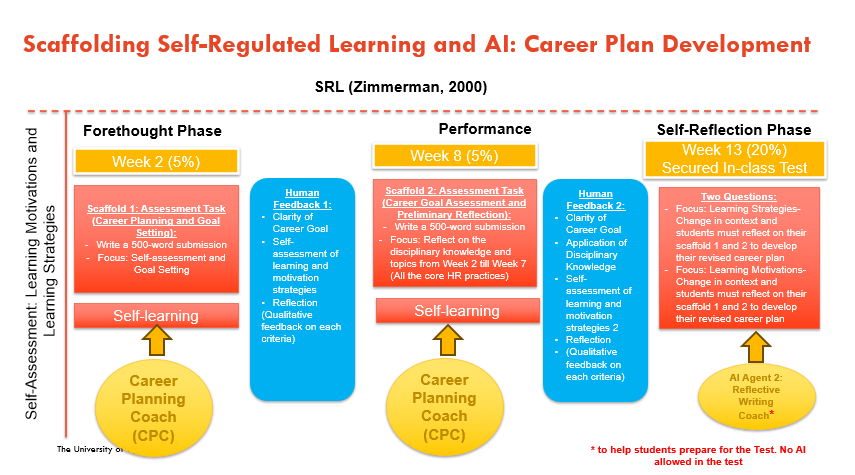
In order not to overwhelm the students, we used a scaffolded approach to allow the students to submit their assessment in stages. This helps to sequentially guide the students through the SRL steps whilst reducing the cognitive load. First, the students would need to submit a 500-word career plan (scaffold 1).
A human marker assessed the first scaffolded submission and provided feedback, focusing on how students had analysed and reflected on their own learning strategies and motivation, and how well these aligned with their emerging career plan.
Following this, the students are expected to have a second attempt using the feedback from the marker and also the new HRM disciplinary concepts (scaffold 2) to revise their 500-word career plan. Like scaffold 1, a human marker assessed scaffold 2 and provided constructive feedback on how their analysis and reflection of the HRM concepts align with their career plan. Following these two scaffolded assessments, the students were expected to develop a final career plan in an in-class test.
How do we know if students have learned
In the final phase, students were not allowed to use AI in the in-class test. We also introduced exam-like questions that introduced new contextual challenges, and we expected the students to draw on their learnings from scaffold 1 and scaffold 2 and apply them in the in-class test. Whilst AI was not allowed in the test, we created an additional bot called “Reflective Writing Coach” using Cogniti to help students practise critical evaluation and reflective writing prior to the in-class test.
The pilot demonstrates how SRL-aligned scaffolded activities are designed to support assessment preparation and skills development (Figure 1).
Did it work?
The evaluation process is currently still in progress. However, our preliminary results after analysing students’ marks for scaffold 1, scaffold 2 and the in-class test suggest that engagement with earlier scaffolded tasks was associated with substantially stronger performance on the final career plan. Further analysis shows that students in the top quartile of scaffold 1 scores achieved, on average, a 37% higher final career plan score than students in the bottom quartile.
Overall, this suggests the staged approach, especially the first scaffold, helps students to do better in the final in-class test. What is more interesting is that the stronger students appeared to demonstrate a stronger academic achievement in the final assessment when compared to their weaker student cohort.
What other educators can take from this
Based on our learnings, the key principles in designing a SRL scaffolding process for educators to navigate the SRL-AI nexus are:
- Use the SRL framework to anchor the scaffolding process. Start by asking the following questions:
- First phase of Forethought: Begin the semester by selecting key learning activities that build students’ goal-setting skills. This is aimed at creating a personalised and authentic learning context that helps students connect with the value of learning, strengthening their interests and commitment.
- Second phase of Monitoring: After goal-setting, develop learning activities that help students engage with the disciplinary knowledge (e.g., topics within the unit) in ways that align with their personal goals and allow them to track how their learning strategies support those goals. Ensure sufficient time for students to practise self-observation and monitoring.
- Third phase of Self-Reflection: In this final stage, students will learn to self-reflect on their performance against their goals, identify gaps and develop future-oriented learning strategies for improvement.
- Design your Learning Activities that Align with Learning Outcomes and the Assessment Task: It is important to ensure that the scaffolded process of SRL activities aligns with the evaluation and formal assessment processes. At each phase, students should receive feedback on their disciplinary knowledge and skills. Ideally, students will be asked to submit a short self-assessment to inform goal development and strategic planning. The feedback should be personalised and targeted at validating positive performance and constructive feedback on how to improve.
- Use AI to personalise and scaffold students’ learning process: Tailor your personalised AI agent (i.e. Cogniti) with customised prompts to support students in answering critical questions and completing tasks that will help students throughout the SRL phases.
- Evaluating if Students Learnt: Design an assessment task that will securely evaluate and ascertain the learning outcomes. This could be in the form of a final exam or in-class test where the elements of skills, which include the ability to self-assess and plan (phase 1), monitor and apply (phase 2) and reflect (phase 3), are securely assessed.
Want to know more?
Our findings indicate that embedding SRL as a core element of pedagogical design provides a coherent, systematic structure that effectively supports and enhances student learning and the development of self-regulatory skills.
You can watch a presentation about this project on YouTube: https://www.youtube.com/watch?v=5PVYBuq3E-k.