
Assessment redesign is rarely driven by a single factor. In a first-year, first-semester Occupational Therapy unit at the University of Sydney, several pressures and possibilities suggested the need for changes to assessment: the University of Sydney Assessment Framework and its response to generative AI; persistent assessment challenges related to a hurdle Interactive Oral Assessment; a continued commitment to equity and inclusivity through Universal Design for Learning (UDL); and a desire to better support students’ transition into university by explicitly fostering self-regulated learning.
These drivers informed the redesign of four assessment tasks across the semester. We are Dr Nicola Fearn, Lecturer in the Faculty of Medicine and Health, and Kria Coleman, Educational Designer in the Devision of Teaching and Learning. Together, these assessments aim to make learning processes more visible, support student agency, and create a coherent assessment journey that balances open and secure assessment approaches.
Assessment as a developmental sequence
Rather than viewing assessments as isolated checkpoints, the redesign conceptualises assessment as a developmental sequence. Across the semester, students encounter multiple opportunities to practise, receive feedback, reflect, and recalibrate their learning strategies. Three of the four assessments are designed as open assessments, where students may use AI as a learning support tool, while one is a secure assessment in the form of an Interactive Oral Assessment (IOA). Each task is intentionally scaffolded to support students who are adjusting to the academic, professional, and cognitive demands of university study.
Assessment 1: Early feedback and learning agency (Week 3)
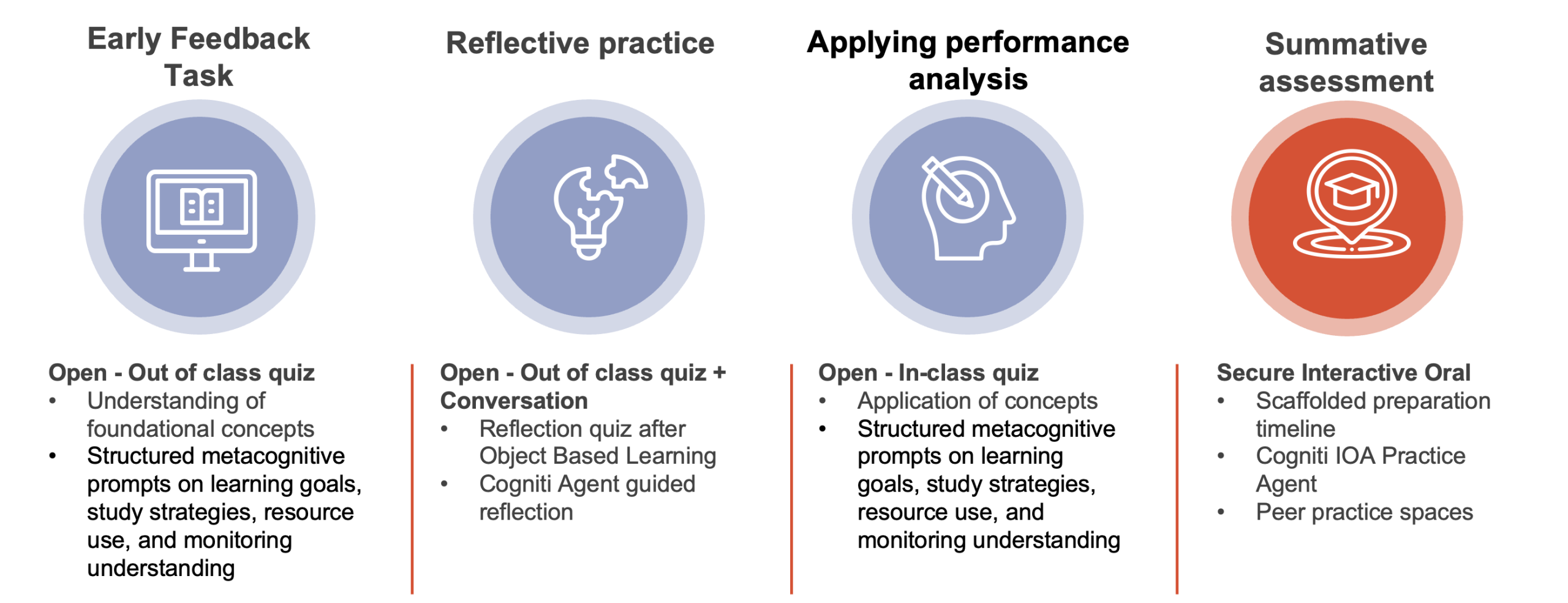
The first assessment is an out-of-class quiz in Week 3, designed as an Early Feedback Task. Its primary purpose is not summative judgement, but early diagnosis and formative feedback. The quiz checks students’ understanding of foundational concepts introduced in the opening weeks of the unit and embeds structured metacognitive prompts.
Students are asked to reflect on their learning goals, study strategies, resource use, and approaches to monitoring understanding. They are also prompted to consider help-seeking, collaboration, and how they respond to feedback. This design is informed by research on early low-stakes assessment and assessment for learning, including work by Helen Harrison
and Kay Colethorpe
and colleagues. This work demonstrates the value of early feedback in supporting student adjustment and engagement.
For many first-year students, this assessment represents their first opportunity to receive university-level feedback. Importantly, it positions learning as something students actively shape, rather than something that simply happens to them.
Assessment 2: Reflective practice through Object-Based Learning (Week 6)
The second assessment builds on an Object-Based Learning (OBL) museum session and focuses on developing foundational Occupational Therapy skills: observation, listening, communication, and professional awareness.
Rather than requiring a traditional written reflection, the task comprises two connected components. First, students complete a short in-class quiz that consolidates their OBL experience, prompting recall and synthesis of observations, peer perspectives, and facilitator input. Second, students engage in a guided reflective conversation with a Cogniti agent, structured around the DIEP (Describe, Interpret, Evaluate, Plan) reflective model.
This conversational format makes reflective processes explicit and intentional. The Cogniti agent scaffolds students through each stage of reflection, pausing to prompt deeper thinking and encouraging students to connect their learning to professional practice. By shifting reflection from a written artefact to a guided dialogue, the task aims to reduce performative writing, increase authenticity, and better support students who may be unfamiliar with reflective practice in a university or professional context.
Assessment 3: Understanding and applying performance analysis (Week 9)
Performance analysis is a fundamental Occupational Therapy process, which involves evaluating how a client performs specific, meaningful activities-or occupations-to identify strengths, limitations, and the underlying reasons for performance breakdowns. Previous cohorts consistently struggled with both conceptual understanding and application of this foundational process. The third assessment, an in-class open quiz, directly responds to this challenge.
Leading up to the assessment, students participate in structured in-class activities that model performance analysis and allow repeated, supported practice. The assessment itself evaluates conceptual understanding while also revisiting metacognitive strategies introduced earlier in the semester. Students are prompted to reflect on how they prepared, how they monitored their understanding, and how they will respond to feedback.
This assessment bolsters a previously under-scaffolded task with preparation opportunities to bridge a gap in translating theory into practice and exemplifies how assessment redesign can address known learning bottlenecks through intentional alignment between teaching activities, assessment design, and feedback.
Assessment 4: A scaffolded Interactive Oral Assessment (Exam period)
The final assessment is a secure Interactive Oral Assessment. While IOAs can offer rich insight into student understanding and professional communication, they are still relatively rare in our curricula and students may need additional supports.
The Semester One, 2025, experience of this hurdle assessment had a concerning fail rate, particularly for those who had limited exposure to oral assessment in their prior education. In response, this IOA is now intentionally scaffolded. Students are provided with a recommended preparation timeline, structured practice activities embedded in timetabled classes, and access to a Cogniti practice agent that allows them to rehearse oral responses and communication strategies in a low-stakes environment. These supports aim to demystify the assessment format and reduce anxiety, while maintaining academic standards and assessment integrity.
Evaluating impact and next steps
To evaluate the impact of the redesigned assessments, multiple sources of data will be collected. These include comparisons of assessment outcomes with previous cohorts, mid- and end-of-semester student surveys, and anonymised responses to metacognitive prompts embedded across tasks.
Together, these data will inform ongoing refinement and contribute to a growing evidence base around assessment design that supports equity, learning agency, and meaningful engagement in the context of generative AI.
Reflections
This assessment redesign reflects a broader shift from assessment of learning to assessment for learning. By foregrounding metacognition, scaffolding unfamiliar assessment formats, and embracing open assessment principles, the unit seeks to support students not only to succeed academically, but to develop as reflective, self-regulated learners at the very start of their university journey.
Key takeaways for educators
Design assessment as a learning sequence, not isolated tasks. Early, low-stakes assessment with feedback can establish learning expectations and student agency from the outset of first year.
Embed metacognition explicitly. Prompting students to reflect on goals, strategies, monitoring, and help seeking supports the development of self-regulated learning, particularly during the transition to university.
Use open assessment intentionally. Allowing AI as a learning support shifts the focus from product to process and creates opportunities to discuss ethical, purposeful tool use.
Rethink reflection formats. Guided conversational reflection with a customised Cogniti agent can make reflective practice more authentic, structured, and accessible, compared to traditional written reflections.
Scaffold known learning bottlenecks. When cohorts struggle with core concepts, aligned teaching activities, modelling, and assessment design can provide multiple supported practice opportunities.
Anticipate assessment barriers and design for equity. Proactive scaffolding, especially for unfamiliar formats like oral assessment, supports diverse learners without lowering standards.
Collect evidence to inform iteration. A multi-modal approach — using assessment outcomes, student feedback, and learning analytics — enables ongoing refinement and strengthens the scholarship of teaching and learning.