
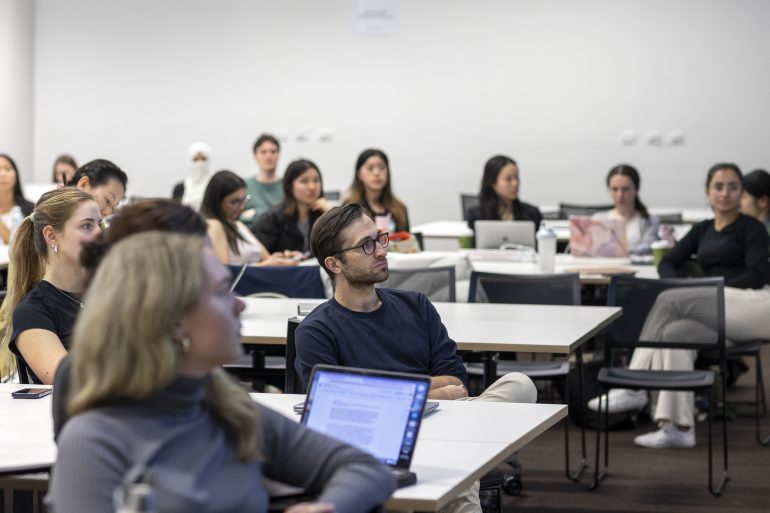
The transition to higher education is never an easy or simple process. Being thrust into independent adult learning is a dizzying shift for Sydney’s students, 7% of whom will withdraw from study in their first year. In this article for Teaching@Sydney, student-partners and second-year students Luke (Bachelor of Medical Science) and Munia (Bachelor of Engineering) reflect on their first-year experiences and share insights, advice and tips that they have taken from their 1000-level teaching and learning journey.
Importance of unit structure
As previous first-year students, we have experienced how overwhelming and daunting university life can be. The ever-growing list of to-dos, deadlines and classes situated all over campus can seem like a lot. However, this can all be managed with a unit structure that makes a first-year’s life – while not generally ‘less work’ – much easier to navigate.
Something that’s slightly above and beyond is including a graph that demonstrates how topics from each week flow into each other, and how relative difficulty or workload might increase. This facilitates better time management and allows first-year students to create their own specialised study plan for the unit. We also found it immensely helpful when the first lecture of a course was entirely dedicated to understanding what would happen during the semester – practicals, seminars, assessments, modes of submission, etc. This allowed us to have greater preparation and better organisation.
Another example of what worked for us was the structuring of mini, invigilated assessments such as tutorial worksheets, workshop quizzes, or (for interactive lectures) tools like Mentimeter that can provide feedback and encouragement. While these approaches led to there being more work, it was super helpful by the time the finals rolled around, with the amount that needed to be crammed being a lot smaller – or none at all!
Meaningful connections
There is an immense shift when transitioning from high school to university, from seeing the same people you know every day to ever-changing classes and courses, each with new faces and various expectations. The biggest challenge we faced as first-years was dealing with the uncertainty and occasional loneliness that came with being in a new environment. Because of this, we valued first-year units that allowed social connection for students to make connections with our fellow students.
Lectures, tutorials, workshops, and practicals can all be vital aspects in the beginning of a first-year’s social life – a lecturer asking us to introduce ourselves to the people next to us has made more than a couple of lasting friendships. Running icebreakers in tutorials throughout the semester, instead of just the initial weeks, really allowed us to get to know our cohort.
One particular bonding experience we haven’t seen often is group quizzes. These are a low-stress way to get marks (which further encourages revision and attendance), and can also end up in unexpected conversations and connections, as students problem-solve together in a shared activity.
The idea of connection is also a two-way street – when tutors or demonstrators humanise themselves, they are seen as less confronting and are more easily approached by students seeking guidance. We really liked when demonstrators and tutors moved around, table-to-table, chatting with us. It made the atmosphere more lively and brought up the energy of the room, making it easier to share and learn.
Passionate educators (makes passionate students)
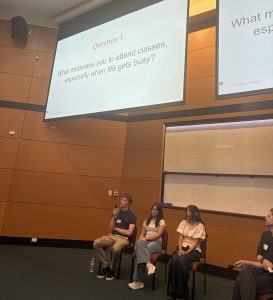
As the semester progresses, we’ve often seen students skip their classes to do work for other courses (especially when there is no attendance mark attached). For us, what keeps students coming back and learning in-person is the energy of our tutors and the knowledge that we would gain more out of attending than just a mark.
Passion might come naturally, but there are small things tutors can do to show it. One such practice was when tutors input their own perspectives, opinions and expertise about the content. Classes were especially engaging when tutors shared a bit about themselves, such as their personal journey and life both within and outside of their careers. As part of this, some tutors shared how they ended up in this position, or activities they’ve been doing recently. This gave us an idea of what life in the future might look like and reminded us that our time at university was more than just studying.
The value of tutorials/small classes is that they are a place where students can discuss and bounce ideas off others, contributing to the refined learning that happens when theory is applied in real-world scenarios. This is an experience that cannot be gained just by completing worksheets during the tutorial time (which can also be done at home). Tutorials are described by our peers in one of two ways: either repetitive and silent, or energising and interactive. Ultimately, it is our tutors who played the key role in shaping this environment, which was crucial for our learning experience in first year.
Real-world application of content
It often feels as though first-year students are expected to already understand their degree-our friends sometimes joke that they chose theirs simply because the name sounded interesting or because it seemed necessary for a future career.
For first-year students, having greater insight into the usefulness or relevance of a course can be extremely meaningful. It reinforces the idea that learning is a continuous, dynamic process-one in which students themselves can meaningfully shape their future field. It can also inform us as to whether this degree, or course, is right for our own interests and aspirations. Something that helped our fellow Student Partner, Marian, figure out whether the unit (and on a broader level, her degree) was right for her was: “some sort of summary that would help explain how this topic is relevant to a future career and where this kind of unit would actually take me.”
Connecting content to personal curiosity and/or current affairs can be a new avenue of engagement, and in our experience has always added a spark of excitement to any form of teaching. From our perspective, relevance and excitement are powerful drivers of engagement-both throughout the semester and beyond, as students specialise within their chosen field.
Conclusion
We appreciate and would like to thank all of our tutors, lecturers and demonstrators who have actively strived to make this university a place of engaging and exciting learning, as well as fostering the opportunity to form friendships and make meaningful connections. We hope that this article was insightful, and that the new cohort of first-years experience all that this amazing university has on offer.