
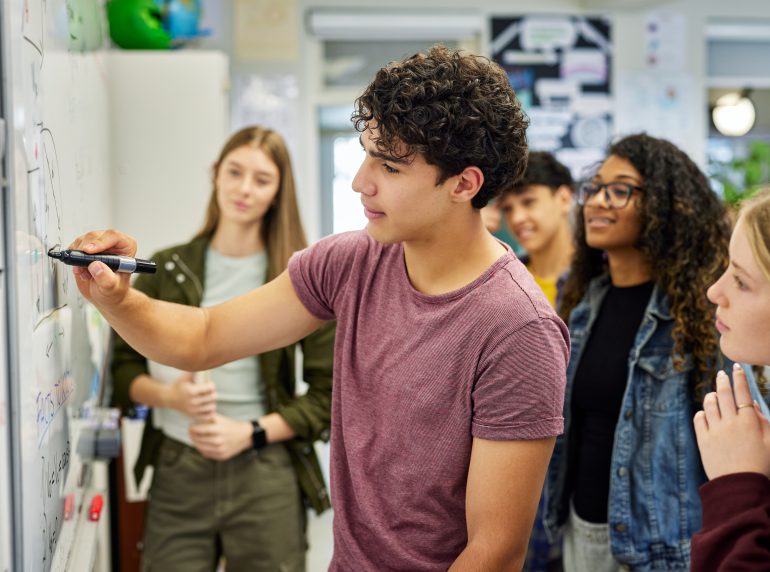
Imagine walking into a first-year undergraduate class and asking students to explain feedback loops, interdependencies, or emergent behaviour. For many students, these ideas feel abstract, theoretical, and far removed from their lived experience-particularly early in their degree.
This was the challenge we faced in PMGT1711, a core first-year unit in Project Management in the Faculty of Engineering. Systems thinking is foundational for understanding project complexity, yet it is also conceptually demanding for novice learners. Despite its importance, students often struggled to engage meaningfully with these ideas when they were taught primarily through lectures or text-based materials. They found it difficult to connect concepts across weeks, and some felt overwhelmed by the volume and abstraction of new ideas.
So we asked a simple question: What if students could build systems together, rather than just learn about them?
The intervention: collaborative whiteboard sensemaking
To address this, we redesigned workshops around collaborative, visual sensemaking activities, using whiteboards as one of the primary learning surfaces. Whiteboard-based collaborative activities have demonstrated effectiveness in supporting students’ internalisation of complex concepts, shifting classroom discourse from answer-making toward genuine sensemaking (Megowan-Romanowicz, 2016; Inouye et al., 2017). Beyond individual learning, the whiteboard functions as a co-creative surface that brings participants into a collaborative mode, facilitating shared understanding around complex and abstract knowledge (Sj├©vaag et al., 2025). Structured cooperative tasks, particularly those that are open-ended and involve sharing group outcomes with peers, have also been shown to deepen engagement and promote higher-order reasoning (Gillies, 2016).
Instead of asking students to complete worksheets, we introduced a sequence of activities where students worked in small groups to:
- map systems visually using causal links, feedback loops, and key actors
- talk through relationships and assumptions as they constructed diagrams together
- revise and refine their representations as new information was introduced
- participate in gallery walks, comparing and discussing different system interpretations across the room
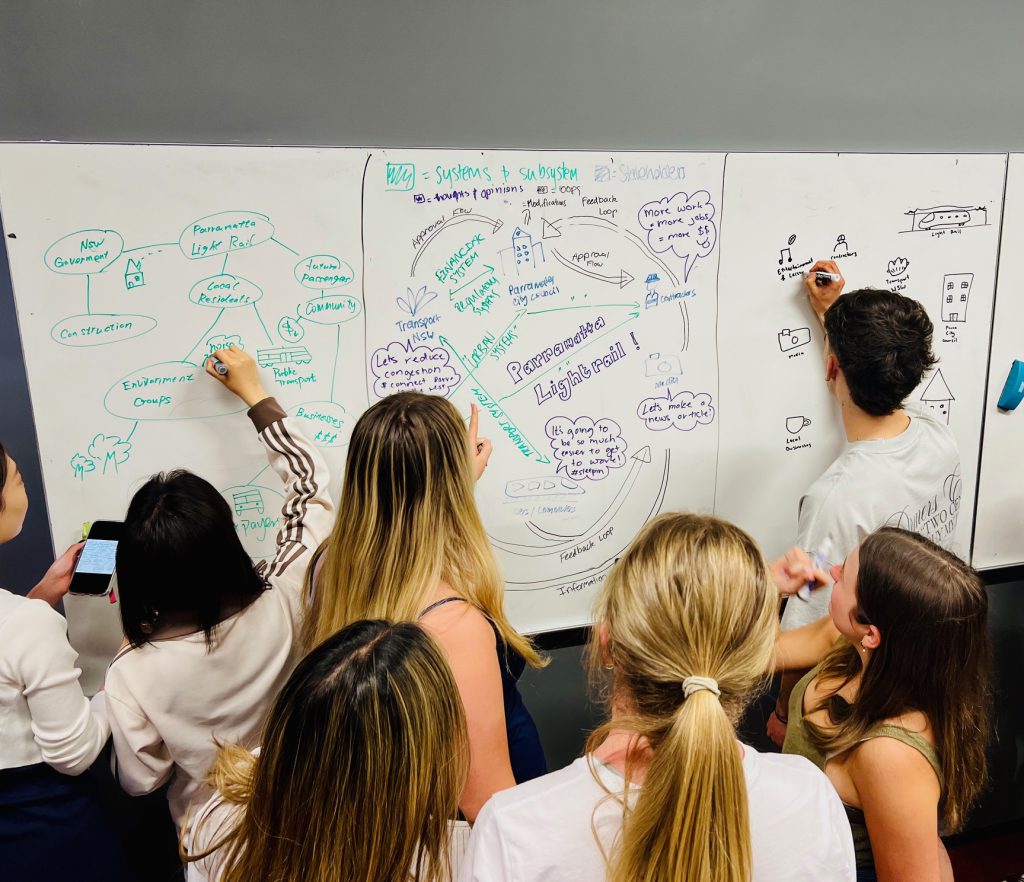
Workshops followed a consistent rhythm: brief conceptual framing, collaborative whiteboard sensemaking, and whole-class synthesis, where groups reflected on differences in how they represented the same system. These activities were not treated as add-ons. They were deliberately positioned as the core mechanism through which abstract systems concepts were explored and understood. They also encouraged active participation – a marked component of this course – especially for those students not comfortable speaking in front of an entire workshop.
Over time, our persistent use of the whiteboard became something of a running joke in the classroom. Students teased us about our “whiteboard obsession” – perhaps unsurprising, given we arrived each week armed with an assortment of coloured markers and an eagerness to map systems wherever there was space. In practice, the colours helped groups distinguish relationships, feedbacks, and points of uncertainty. Recognising that not all students felt comfortable working at a whiteboard, we also provided large sheets of paper so groups could work collaboratively around tables if they preferred. This flexibility proved important for maintaining participation and momentum across the room.
What we noticed
The shift in classroom dynamics was immediate and sustained. We witnessed the initial hesitancy of students to engage in front of their peers begin to fade. Groups initially began as random assignments, encouraging collaboration with new individuals’ week to week. As the semester progressed, students then self-selected into final project groups where these activities began to foster team cohesion and communication – both of which were vital to the success of their final group projects and associated in-class presentations. Students became more willing to talk through uncertainty, test ideas aloud, and challenge each other’s interpretations. The activities also provided a space where engagement by us, as lectures and facilitators, was no longer daunting but rather an opportunity to talk through reason and express differing viewpoints. Whiteboards created a low-stakes environment where it felt safe to erase, redraw, and rethink ideas together.
Across the semester, students repeatedly described these activities as one of the most valuable aspects of the unit. Many commented that visual mapping helped them retain and apply systems concepts, rather than simply memorising definitions:
“This balance between theory and practice made the learning experience interactive and helped solidify complex ideas like system dynamics, causal loop diagrams, and the different types of project complexity.” – PMGT1711 student
Others noted that seeing different groups’ system maps helped them recognise that complex problems can be understood in multiple, equally valid ways.
A recurring theme in student feedback was that these activities helped demystify systems thinking. Rather than searching for a single “correct” answer, students learned that understanding emerges through dialogue, comparison, and reflection-an insight that aligns closely with real-world project practice.
“This unit has been one of my favourites so far. I particularly appreciated how both the facilitator and lecturer approached teaching systems thinking — a topic that can easily feel abstract — in such an engaging and practical way.” – PMGT1711 student
Why this matters for first-year undergraduate students
For first-year undergraduate students, systems thinking can feel distant from their immediate academic or professional experience. Collaborative sensemaking helped bridge this gap by anchoring learning in shared exploration rather than individual abstraction. Students reported that these activities supported not only their conceptual understanding, but also their confidence in participating, communicating ideas, and working through complexity with peers. In this way, the workshops supported both disciplinary learning and broader graduate capabilities such as teamwork and critical thinking.
As enrolments in PMGT1711 have grown – reaching over 200 students in 2025 and with an expected further increase of up to 30% in 2026 – we have deliberately maintained smaller workshop classes rather than consolidating into larger groups. In 2025 this meant three classes; in 2026, four. This commitment to smaller cohorts allows students to build stronger relationships with their peers over the semester, creating the familiarity and psychological safety that collaborative sensemaking genuinely depends on.
What we learned as educators
Three lessons stood out from this experience:
- Make thinking visible. Shared visual spaces externalise reasoning and support deeper discussion.
- Treat sensemaking as social. Complex ideas become more accessible when students negotiate meaning together.
- Consistency builds confidence. Repeating a familiar activity structure allows students to focus on ideas rather than mechanics.
Perhaps most importantly, this approach reinforced that teaching complex concepts does not require simplifying them away. Instead, it requires creating learning environments where complexity can be explored collaboratively and constructively. The discussions that emerged as a result of these sessions demonstrated multiple avenues of learning for the students, including learning by doing and learning from peers.