
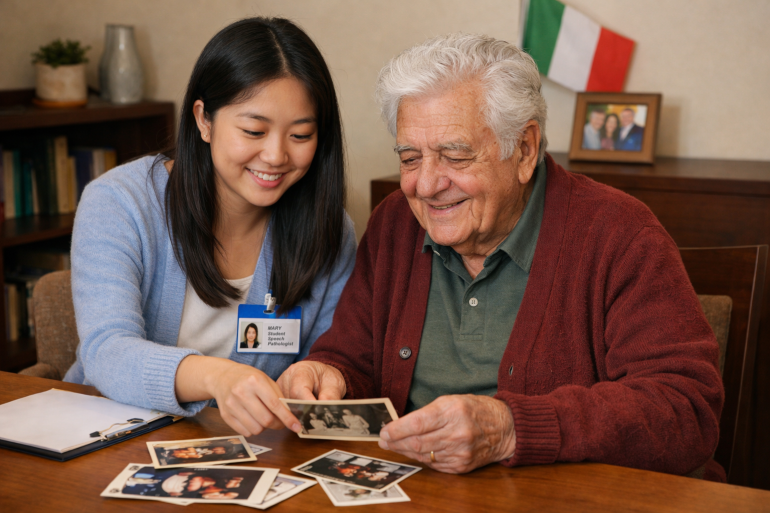
“Are you, my daughter? Take me home!”
You pause, look around, and realise that neither the question nor the request reflects reality. You are a clinician – not her daughter; this is her home – an aged care home. The person asking the question is living with dementia, and in that moment, you are unsure how to respond.
These are the kinds of real-world communication challenges that speech language pathology students encounter during their aged care placements. When asked what would better prepare them to deliver high-quality care, students shared that they struggled with initiating and sustaining meaningful and appropriate conversations with people living with dementia. They expressed uncertainty about how to respond in ways that move beyond task-focused interactions to conversations that preserve personhood and dignity, and honour identity and history.
In response to this challenge, clinical educator and lecturer in speech pathology, Dr Sarah El-Wahsh and doctoral candidate and educator Jacob Elmasry, developed a simulated learning tool using Cogniti. Cogniti is Sydney’s homegrown platform that allows educators to take control of generative AI to enhance teaching, learning and assessment. Sarah first encountered Cogniti at an Educational Innovation workshop at The University of Sydney, where educators demonstrated how conversational agents could support communication training. What stood out was the accessibility of the platform: educators can build customised, realistic scenarios without advanced technical expertise. This made it feasible to rapidly design and implement a dementia-focused simulation aligned with real placement challenges. Building on this discovery, Sarah used Cogniti to develop an AI chatbot agent designed to model and represent a person living with dementia. The goal was simple yet powerful, to provide students with a safe, supportive environment to practise conversations, build confidence, and learn to respond in compassionate ways to better-support their entry into real-world clinical interactions.
Combining explicit teaching with AI simulation
AI agents supplement, instead of replace, the fundamental human connections that are essential to teaching and learning. The Cogniti chatbot simulation was intentionally and thoughtfully integrated into the broader designed structure and learning sequence at the start of students’ aged care placement block. Students first receive explicit instruction on evidence-based dementia communication strategies (e.g., emotional attunement, acknowledgement, validation, reassurance, the use of clear and simple language, gentle redirection, and understanding altered reality and its impact on behaviour) (Sunjaya, Schreiber, Kantilal, Davies, & Griffiths, 2025). They then immediately apply these strategies within realistic conversational scenarios using the simulation tool. This intentional progression supports the transfer of knowledge into action, turning theoretical concepts into practical skills.
Using the evidence-base to design a realistic persona
The AI is programmed with a detailed dementia profile reflecting moderate Alzheimer’s disease. It may demonstrate disorientation in time or place, repetitive questioning, misidentification, grief responses about deceased loved ones, anxiety, or emotional distress. These characteristics are taken from the clinical research literature (Sandilyan & Dening, 2015). While designed to act as an individual patient, the team intentionally left it unnamed, thus encouraging students to name the person themselves and begin interactions with a personalised greeting (e.g., “Hi [name]”). This helped students to foster engagement and a sense of autonomy in how they engaged in the interaction.
Importantly, the chatbot does not present in a fixed or predictable way. It has been intentionally modelled to showcase individual patient variability. In one interaction, the agent may be calm and reassured, while in another, the agent may present as confused or distressed. The agent may occasionally show word-finding difficulties, may respond positively to validation or become frustrated if corrected. As a result of these programmed possible behaviours, students encounter novel presentations each time they engage in practice with the agent. This prevents students relying on scripted responses and instead encourages students to adopt and practice flexible, responsive, and person-centred communication.
Using two modes to help students experience, reflect and critically evaluate feedback
When students type the command word “Feedback” into the chatbot, the AI shifts from resident mode into supervisor mode. It has been prompted to provide concise, structured feedback using the “Glow and Grow” framework
– highlighting strengths while offering targeted, practical suggestions for improvement aligned with dementia communication principles.
While the AI feedback is often insightful and detailed, it is not infallible. This limitation is pedagogically valuable. Rather than positioning the feedback as authoritative, students are required to critically appraise it. Guided reflective questions are discussed verbally during a facilitated group debrief led by the supervisor, such as:
- Do you agree with the feedback?
- How might context change your response?
- What are the ethical considerations in this situation?
Through this process, students move beyond passive acceptance of automated feedback. They weigh suggestions against their own clinical reasoning, contextual factors, and person-centred principles. In doing so, they cultivate higher-order skills, including clinical judgement, adaptability, and ethical decision-making.
What students are saying
Student feedback has been overwhelmingly positive, with many describing the simulation as both practical and transformative in building their skills and confidence. Drawing on their reflections, students consistently report feeling better prepared, less anxious, and more ready to engage with residents in a person-centred and responsive way.
One Master of Speech Language Pathology student shared:
“The chatbot gave realistic responses that reflect what patients with dementia may feel or say.”
She noted that the realism extended beyond scripted confusion, with the chatbot conversation mirroring her real clinical experience:
“I was surprised when the chatbot asked if they could hold my hand because I was asked the same question from a resident with dementia during placement.”
For this student, the value was not only in the interaction itself, but in the practical feedback that followed: “Based on [the feedback], I tried to work on the areas to grow, like expanding on validation during interactions with residents who have dementia.”
Another Master of Speech Language Pathology student highlighted the tool’s ability to develop a psychologically safe environment for skill development, saying:
“Working with people with dementia can be challenging and emotionally sensitive, and at times it brings up my own anxiety. What I love most about the chatbot is that it feels like a safe space to experiment. I can try different ways of responding, see how the conversation shifts, and get more comfortable sitting with the interaction and adjusting my approach until something connects.”
Collectively, these reflections demonstrate that the simulation does more than build communication techniques, it strengthens emotional awareness, reflective capacity, and clinical reasoning.
Using this approach in your own teaching
To bring this approach into your own teaching, ask yourself the following questions:
- Have you observed any communication challenges that your students encounter? Where do they feel stuck, unsure, or anxious?
- Can you create and train a chatbot to address these challenges using Cogniti? You might want to consider building in feedback by switching the chatbot into “supervisor mode” when it receives a command word (e.g., “Feedback).
- How can you invite ongoing student feedback to iteratively refine and strengthen your chatbot over time?
Why not give it a go and see what becomes possible in your own teaching?
Conclusion – practising compassionate communication before it counts
Communication with people living with dementia is complex, emotionally demanding, and deeply human. Students must learn to embrace uncertainty, respond flexibly, and communicate empathetically. So, when a resident asks, “Are you, my daughter?” or requests to be taken home, students are no longer unsure how to respond, but prepared to meet the moment with confidence, calmness, and compassion.