Each year roughly 140 students will enrol into the postgraduate Doctor of Veterinary Medicine (DVM). Coming into this program from diverse undergraduate backgrounds, the transition to year 1 of the DVM can be challenging given the program’s time-heavy schedule and information-dense content. Traditional transmission-based approaches to teaching that emphasise rote learning and memorisation can contribute to cognitive overload, poor retention, confusion, and reduced confidence. For educators, knowing how to meet students where they are can be challenging given the diverse range of students’ prior learning and experience and confidence in self-directed learning.
Designing to support active learning
To address these challenges, the teaching team redesigned learning around several complementary pedagogical strategies. First, the threshold concept Structure-Function was used to identify and prioritise the foundational ideas students must grasp in order to progress to deeper understanding. In histology, tissue architecture became a central organising concept, helping students connect structure and function across organ systems. Second, teaching was informed by Universal Design for Learning (UDL) principles, recognising the diverse needs and learning preferences of the cohort. This led to a more blended and flexible learning environment that incorporated multiple ways of engaging with content, including visual explanations, drawing, and guided application. Third, the curriculum incorporated Active learning, shifting emphasis away from teacher-led content delivery toward student-centred preparation, in-class participation. More about the redesign here.
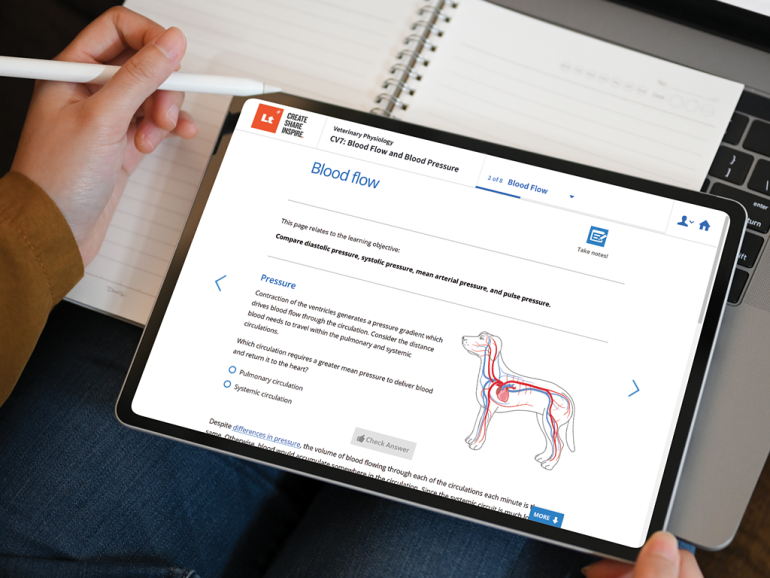
Within this broader educational redesign, Lt (formerly KuraCloud), an interactive cloud-based learning platform developed by ADInstruments, was introduced as a key educational technology solution. Lt enabled the delivery of structured, multimedia-rich learning activities that students could access flexibly before, during, and after class. The platform supported a more consistent and scaffolded approach to foundational learning by combining text, images, videos, quizzes, and other interactive elements in a single online environment. This made it possible to better prepare students for face-to-face classes, support independent learning, and provide opportunities for repeated engagement with complex material at an individual pace.
Evaluating our design’s impact
A survey was undertaken to explore the student experience around this platform:
Reducing overload and improving retention
This theme was one of the strongest in the survey. Students largely felt that Lt helped them navigate the heavy information load of DVM1 by breaking complex content into smaller, more manageable steps. Responses also suggest that the platform reduced confusion by making relationships between structure and function clearer.
Positive responses (Agree + Strongly agree)
- Managed information density by breaking learning into manageable steps: about 70/75 students (~93%)
- Helped retain key ideas better than lectures and practicals alone: about 64/75 students (~85%)
- Reduced confusion by clarifying structure–function relationships: about 70/75 students (~93%)
The strongest result in this section was not simply that students liked the platform, but that they experienced it as a way of making difficult content more navigable and coherent.
Teaching for diversity (UDL): multiple ways to learn, engage, and express
This theme strongly supports the argument around learner diversity in the DVM cohort. Students reported that Lt gave them multiple ways to engage with content — for example through reading, guided videos, interactive tasks, and microscopy — without forcing everyone into the same mode of learning. Students also valued the ability to work at their own pace, which is especially important in a cohort with different educational backgrounds as it supported different starting points.
Positive responses (Agree + Strongly agree)
- Offered multiple ways to learn and choose strategies that suited preferences: about 71/75 students (~95%)
- Supported students who needed more repetition/time than others: about 70/75 students (~93%)
- Supported learning when background knowledge differed from peers: about 67/75 students (~89%)
Active learning design
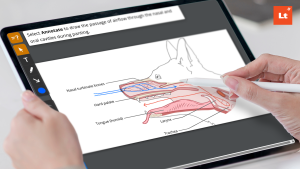
Responses under this heading suggest that Lt was effective because it was designed as a sequence for learning, rather than simply a collection of resources. Students generally agreed that it prepared them for practical classes, helped them learn more deeply through a staged sequence of concepts, videos, microscopy, and application tasks, and made face-to-face time more valuable. The practical preparation item appeared especially strong.
Positive responses (Agree + Strongly agree)
- Activities prepared me effectively for practicals: about 69/75 students (~92%)
- Learning sequence helped me learn more deeply: about 66/75 students (~88%)
- Made in-person time more valuable (more active learning, less catching up): about 61/75 students (~81%)
These results suggest that Lt supported a shift from passive delivery to active and better-prepared participation. The somewhat lower score for “making in-person time more valuable” may reflect variation in how consistently students completed pre-work, but the overall pattern still shows that most students saw the platform as improving the quality of practical and face-to-face learning.
Engagement, wellbeing, and learning climate
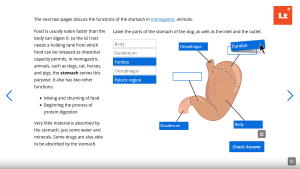
This section is particularly useful because it captures the broader student experience. Students generally reported that Lt made the module feel more engaging, more learnable, and more supportive of practice and clarification. Confidence gains were also positive overall, although this item was a little more mixed than the others, which is understandable given that confidence is influenced by many other factors beyond one learning platform in a 12 credit point unit.
Positive responses (Agree + Strongly agree)
- Made the module feel more engaging and “learnable”: about 69/75 students (~92%)
- Helped with clarifying and providing practice: about 68/75 students (~91%)
- Increased my confidence across the semester: about 63/75 students (~84%)
In a demanding first-year postgraduate setting, that matters not only for learning, but also for motivation, wellbeing, and students’ sense that success is achievable.
Conclusion
Students overwhelmingly reported that Lt improved their learning experience, and most said they would recommend it to future students.
Positive responses (Agree + Strongly agree)
- Overall, Lt improved my learning experience in this unit: about 71/75 students (~95%)
- I would recommend Lt to future students: about 71/75 students (~95%)
- Lt should be expanded to all organ systems: about 68/75 students (~91%)
Lt proved to be an effective learning platform in DVM1, helping students manage a demanding first-year curriculum by making complex content more accessible, structured, and engaging. Through multimedia resources, scaffolded activities, and flexible access, it supported preparation, revision, and self-paced learning. Student feedback showed it reduced overload, improved understanding, and created a more inclusive, active learning experience, highlighting its value for foundational teaching.