A student’s first year at university is the springboard to their learning journey. Making a successful transition to university is crucial to helping students develop the skills, agency, confidence, and sense of belonging, all of which can positively influence their trajectories throughout their studies and beyond. Since 2020, our team within the Division of Teaching and Learning (DTL) has been supporting educators in 1000-level ‘transition’ units to meet the unique needs of first-year students. The 2025 program offered increased depth and variety to accommodate a large, diverse cohort of transition educators.
Sydney’s challenge
Large institutions can be isolating and students, particularly those from diverse backgrounds, often feel overwhelmed. Educators have a key role in helping students develop a sense of community, purpose, and drive to set them up for success. Sydney’s scores in successive Quality Indicators for Learning and Teaching (QILT) surveys highlight the opportunity to support educators as a strategic approach to improving students’ experiences. The transition support program aims to build the capacity of educators to help first-year students engage with their learning, connect with peers, develop practical skills to support their studies, find help when they need it, and contribute positively to their learning environments.
Program overview
The transition support program springs from Sally Kift’s transition pedagogy, a concept fundamentally concerned with equity. It recommends a systemic and holistic approach based on inclusive curriculum design, embedding transition support into 1000-level units, and partnership between professional staff, academic staff, and students. In collaboration with unit coordinators, faculty tutor training leads, educational designers, and student partners, we provide resources and training to support educators in transition units, evolving the program each year in response to changing educational conditions, research, and feedback from participants.
In 2025, the program comprised professional development for educators, resources, and opportunities for networking and ideas sharing, including:
- Collaboration between DTL educational designers and unit coordinators to enhance units in line with UDL principles.
- Class activities embedded into units to support connection, academic skills, and personal development.
- Paid professional development including a suite of workshops on teaching skills, University policy, AI, and diversity, equity and inclusion. We also offer the first-year Transition and Teaching symposium with unit coordinator, tutor/demonstrator, and student panels, and keynote from Ryan Naylor, who highlighted the importance of a caring and well informed approach to transition in order to support student’s wellbeing and learning.
- Paid group coaching throughout the year to support tutors and demonstrators to work on challenges and share effective teaching strategies, and paid coach training to equip tutors and demonstrators with foundational coaching skills to support their colleagues, teaching teams, and students.
[I learned] the importance of recognising the diverse challenges students face as they adjust to university life. …as a tutor, I play a key role in easing this transition by being approachable, fostering belonging, and encouraging active participation. Building these early connections can significantly improve student confidence, engagement, and overall success.
Outcomes and impact
In 2025, the program achieved significant reach and positive impact, including:
- 1,736 hours of training, supporting 413 tutors and demonstrators
- 348 hours of coaching, supporting 117 tutors and demonstrators
- 51 units (62 instances), comprising 36,274 students, representing 25.6% of all first-year enrolments
- 92% of tutors and demonstrators found the training somewhat or very useful.
Participants expressed appreciation for the program’s effectiveness in building confidence, fostering inclusive practices, and developing practical stratigies. Evaluation feedback highlight the enhanced empathy, agency, and skills:
- “[I gained] a deeper awareness of the barriers to learning and engagement faced by CALD (Culturally and Linguistically Diverse) students…help[ing] me recognise that behaviours I may interpret as disinterest could instead stem from language barriers, cultural expectations, or prior educational experiences. I left with practical strategies to make my teaching more inclusive, such as giving clearer instructions, providing greater scaffolding, avoiding idioms, and offering multiple ways for students to participate.
- “[I learned] how crucial it is to create an interactive and supportive learning environment. …strategies such as open-ended questioning, active listening, and incorporating short activities can make tutorials much more engaging and effective. The session highlighted that effective teaching isn’t just about covering content but about fostering student curiosity and participation.”
Strategic alignment
The transition support program has been developed to be an impactful part of the University delivering on its Sydney in 2032 strategy, which aspires to deliver transformational, student-focussed education, nurture connection and belonging, provide innovative staff support programs, and for “students [to] know the whole University community is invested in their success.” The program translates these aspirations into tangible outcomes in building the capacity of educators and nurturing peer-learning networks.
Through ongoing productive collaborations, the program upholds the University’s collective excellence ethos and the ‘Collegiality’ pillar of the University’s Academic Excellence Framework, and supports its ‘Education’ pillar (based on the internationally-recognised Advance HE UK Professional Standards Framework), by offering educators professional development across the Framework’s five dimensions of practice.
Aligned with the University’s One Sydney, Many People strategy, the Program models respect for cultural connection to Country by providing information about Acknowledging Country, the University’s Guidelines for Aboriginal and Torres Strait Islander communication, and cultural competence resources from the University’s National Centre for Cultural Competence.
Looking forward – ideas for practice
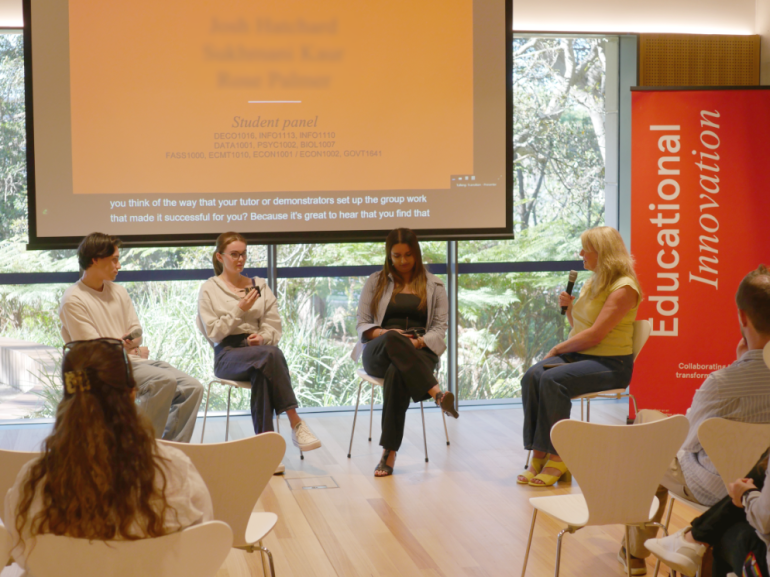
To celebrate the successes of the 2025 program and bring together the community of transition educators, we hosted an end of year event, Transition 2025/26: connection, celebration, iteration. Tutors, demonstrators, unit coordinators, members of the Education and Students portfolio, and Associate Deans Education gathered to listen, ask questions, make connections, share stories, and generate ideas.
The event featured educator and student panellists who shared practical insights from their transition experiences:
- Andy Tran highlighted how building routine, fostering inclusion, and facilitating social interaction support successful transition in first-year data science
- Nic Fearn reflected on her own transition from clinician to educator while helping students develop professional identity and establish future networks
- Yuqing Fang described how the program’s training and coaching helped her build peer connections, gain communication confidence, and facilitate collaborative learning
- Philip (Piripi) McKibbin shared how normalising struggle and valuing diverse perspectives supports international students, and how attending to student feedback created a culture of mutual care
- Student panellists Josh Hatchard, Sukhmani Kaur and Rose Palmer offered advice for tutors and shared examples of teaching practices that positively shaped their experience
Program lead Sarah Humphreys closed the event by inviting participants to reflect: What does successful transition look like to you? How can we achieve this together?
Get involved in 2026
Ready to join the transition educator community? Access event recordings and resources on the transition resources Canvas site, or register for the 2026 symposium to connect with colleagues and build your practice.
Contact transition support program lead Sarah Humphreys: [email protected]