
Everyone loves a good story and using storytelling in teaching is a powerful tool. With their relatable characters and vivid details, stories can engage both cognitive and emotional processes in the brain, and as such are an effective way of enhancing learning and memory.
Embedding stories into science teaching
Science, technology, engineering and maths (STEM) disciplines may not seem a natural place to use stories, but in the fields of infection and immunity we have a few good ones. When we teach vaccination, it is customary to relate the story of how Edward Jenner inoculated his gardener’s son with cowpox after observing that milkmaids exposed to this related virus didn’t die of smallpox. Likewise, the story of how Barry Marshall showed the link between Helicobacter pylori and gastric ulcers by drinking a cocktail of the bacteria from the lab is as captivating as it is nauseating. Patient case studies, particularly those with convoluted pathways to diagnosis, also bring with them an element of mystery solving that make them a favourite with students.
These types of stories bring the human experience into our classrooms. However, not all concepts we teach have a quirky historical background or even a relevant case study. Many foundational scientific concepts were worked out through mundane, hard work, where knowledge accumulated in small increments, eventually coalescing into the understanding we have today.
An alternative to ‘real-life’ stories
Instead of real-life stories, we can consider how to make use of fictional narratives. Thinking of the intricate developmental pathways of immune cells, I was reminded of the children’s ‘Choose Your Own Adventure┬«’ (CYOA) book series. In these books, the reader assumes the role of the main character, who is then presented with choices that determine the subsequent adventures and plot outcome (the more bizarre and macabre, the better). There is a striking similarity between the fate of these characters and our developing immune cells. Both have multiple potential fates and a high rate of untimely death. This similarity prompted me to develop a CYOA-inspired immunology learning activity. The CYOA format offers the storytelling aspect, but also something else I was looking for – more active learning opportunities.
Using decision-making for active learning
In STEM disciplines, approaches that incorporate active learning have long been shown to improve student performance. As a tool of constructivism, active learning approaches vary widely, but all involve students in ‘doing something’ that helps them construct knowledge and understanding. In the field of immunology, there are many concepts that, even with a background in biology, students find foreign and complex. The introduction of more active learning approaches has the potential to help students learn these difficult concepts. The CYOA format is, at its heart, a decision-making activity, something that prompts the participant to consider options and consequences, and in doing so, build knowledge.
How to build a CYOA decision-making activity
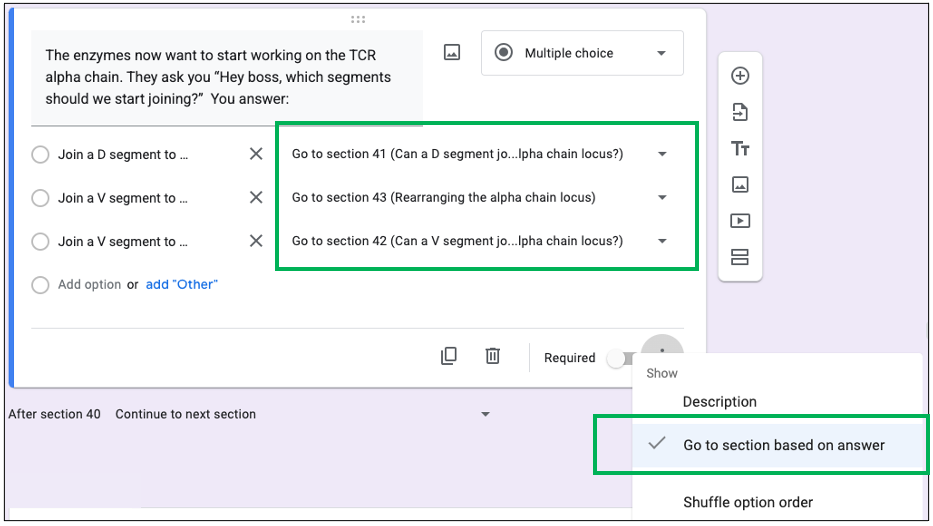
But the question remained: how to build a CYOA-style activity? Not keen to mimic the full CYOA experience and produce a hard-copy book, I opted for an online approach. But creation of an online learning activity such as this can potentially require a specialised development platform and either a steep learning curve or an expensive license, or both. However, without programming expertise or funding, and cognisant that there were others like me, I considered solutions that were accessible and free to use. I realised that, with its simple branching logic, the survey administration platform Google Forms can be co-opted into a decision tree-based learning activity. Instead of using the default ‘Continue to next section’ option, the ‘Go to section based on answer’ option allows you to direct respondents to different sections (and therefore, storylines) when they select different answers to a multiple-choice question. Google Forms also allows images and videos to be embedded, an important addition that enhances the narrative.
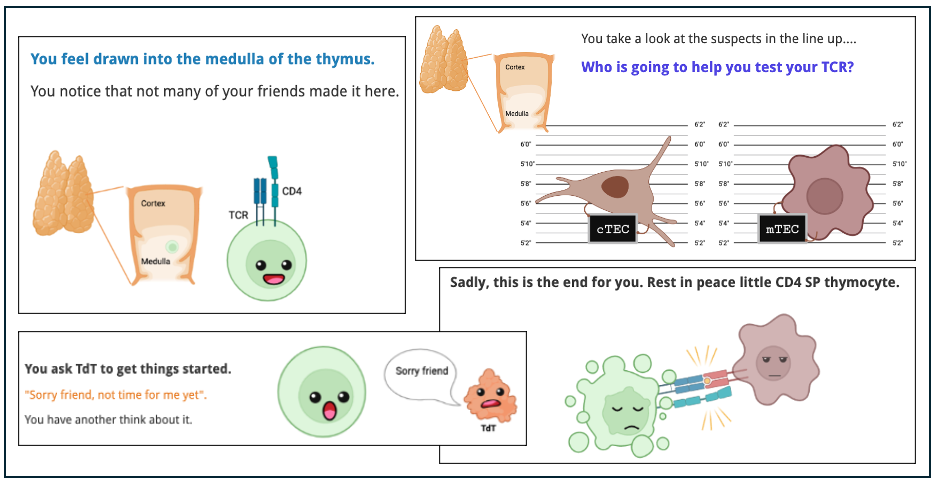
The online activity was designed to support student learning of an immune cell developmental process after a lecture given on the same topic in a 3000-level immunology unit. Named ‘The Life and Death of a T cell’, it was built around the story of a stem cell with a dream, a dream of becoming a ‘helper T lymphocyte’, a particular type of white blood cell. The activity uses personification storytelling, where students assume the role of this cell and are responsible for navigating it through developmental decisions, all the while encountering adversity, suspense and plucky characters with attitude. Like the CYOA books, the story branches into multiple ‘storylines’, and there are six potential endings which include a dream fulfilled, new fates and of course, tragic demise. These elements come together to create an activity that aligns with ‘Universal Design for Learning’ (UDL) principles. Providing learners with choice and autonomy, along with nurturing joy and play, has been shown to enhance meaningful engagement with the content and therefore learning.
Dipping a toe into the H5P waters
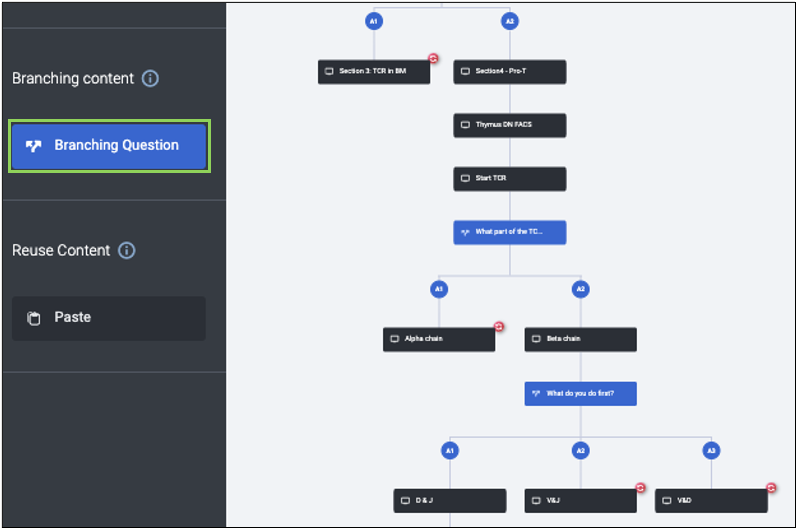
Google Forms worked well with the CYOA-based activity, however as I tinkered with extending the activity I started to run into limitations. For instance, the ‘Back’ button cannot be disabled, allowing students to easily reverse decisions and abandon pathways. Also, besides choosing a path, there are no other options for interactivity. It was about the same time that a colleague flagged the University of Sydney’s purchase of an enterprise license to H5P. As a content creation platform, H5P allows you to embed interactive elements into web-based learning activities. Fortuitously, it has a ‘Branching Scenario’ option, which is perfectly suited to building a decision-making activity. It also has a lot of fun interactive elements, such as hotspots, drag the words and MCQs with instant feedback that help engage the students and give them instant clarification of tricky concepts.
What do the students think?
Student feedback on the CYOA activity has been overwhelmingly positive, with responses highlighting both increased engagement and deeper understanding. Across three cohorts, students consistently described the activity as useful for learning and highly enjoyable. Many students commented on how the decision-making and storytelling aspects made complex science feel more accessible and memorable. They felt that being actively involved in the learning process rather than just passively receiving information helped them make sense of the difficult concepts they had encountered in the lecture. Several students mentioned that they were surprised by how much they enjoyed the activity, and by how engaging it was.
As one student put it:
This is definitely the best learning tool I have ever encountered during uni.
Another remarked:
Wonderful way to learn I was very engaged.
The interactive format, which placed students at the centre of decision-making, was a key factor in its success. Students valued the sense of agency and the opportunity to explore the consequences of their choices. There was also a strong call for more activities like this in other parts of the unit, with one student noting:
It was an excellent experience, and I hope similar activities can be provided for other Immunology topics as well.
Overall, the feedback suggests that bringing active learning, storytelling, and decision-making into the classroom doesn’t just help students learn, it transforms their experience, making even the most complex science both accessible and enjoyable.
Tips for educators looking to create a decision-making learning activity
Whether you’re teaching immunology or medieval history, the principles behind this approach can translate across disciplines. Here’s how to get started:
- Either Google Forms, H5P.org (free version) or H5P.com (paid version) are suitable, so use whichever system suits your context.
- Start small and build on it when you have time. Creating an intricate story with numerous branches and endings is overwhelming from scratch (and does take time). Begin with a single pathway and 2-3 decision points, then expand as you see what works for your students. H5P in particular has the flexibility to tinker and insert new story elements anywhere in the branching scenario when you think of them.
- Incorporate images or even videos throughout. Many students commented on how helpful the visual aspect of the story was for engaging them in the activity and cementing their learning.
- Give feedback on ‘wrong’ choices. Another frequent comment from students was the benefit gained from instant feedback.
- Incorporate options to return to an earlier branch point, rather than the beginning, if a decision leads them in the wrong direction. When students had to go back too far, they often became discouraged, and this deterred them from continuing the activity.
- Be creative and have fun with your characters!
Acknowledgements
Huge thanks to Gareth Denyer for pointing me in the direction of H5P and to Helen Ritchie for helping with student feedback surveys to understand the student response to this activity. Thanks also to Minh Huynh for feedback on this article.