
When students have crossed the stage at their graduation and have left the Great Hall one last time, how do we know what they are taking with them? If you run into a student five years afterwards, what would you expect or hope to hear about how they applied their education to higher academic levels or industry? Course outcomes are a vital part of the system, guaranteeing that content and skills promised by the curriculum have been delivered. The process of developing outcomes also offers opportunities for faculties to define the learning that they expect of students and to align units to form a coherent program.
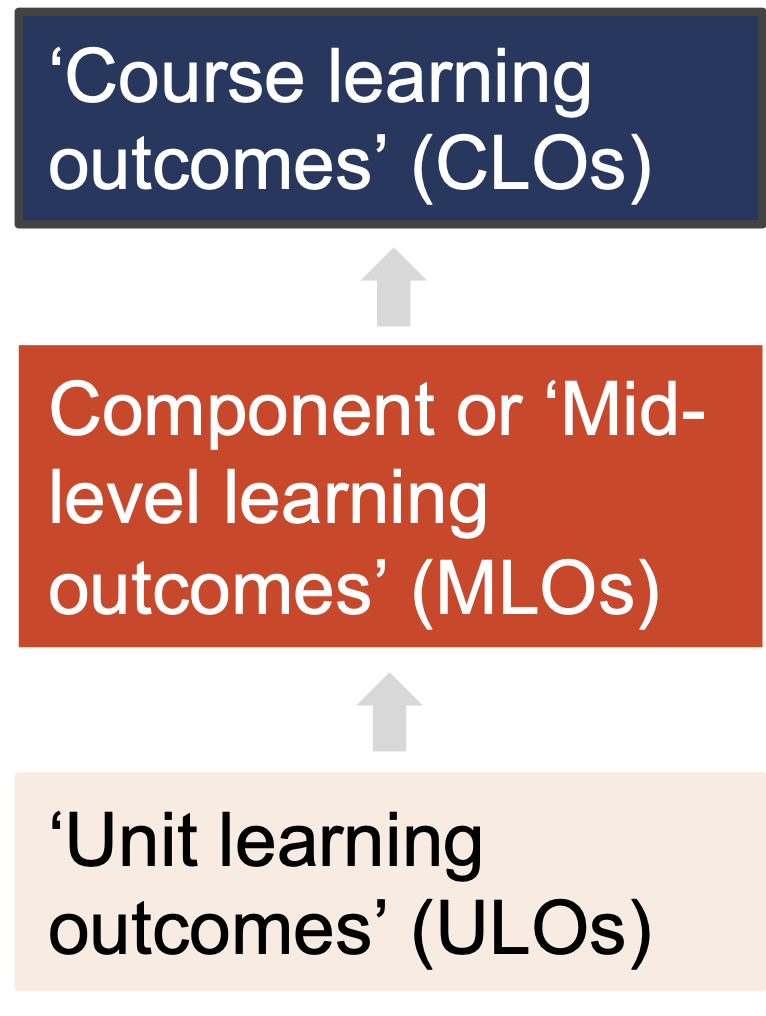
This post addresses how to write effective learning outcomes for courses, course components such as majors, and units. Alignment between these three is critical.
Course Learning Outcomes (CLOs) are specific, measurable statements detailing what students should know, understand, and be able to demonstrate by the end of their degree. In the TEQSA guidance note on course design, they are defined as:
a statement of what a student will know, the skills they will learn to apply and the level they will be able to demonstrate … at completion of the course.
Course Learning Outcomes:
- Guide curriculum design and assessment, typically incorporating knowledge, skills, and application, to ensure all graduates of the course meet the stated educational standards.
- Support good learning and teaching, enabling students to navigate a course with confidence, and ensure the integrity of the qualifications we award.
- Bridge the gap between teaching activities, learning tasks, and assessment methods, ensuring they all align.
- Are published for students to explicitly define the minimum level of achievement required for success.
- Need to be assessable through secure and trustworthy tasks.
The Higher Education Standards Framework (HESF) requires that “learning outcomes for each course of study are specified, consistent with the level and field of education of the qualification awarded” and that “on completion of a course of study, students have demonstrated the learning outcomes specified” (Threshold Standards 1.4.1 and 1.4.3 respectively). The accreditation bodies for professional degrees have similar standards for assurance of learning of published CLOs.
CLOs are not intended outcomes or teaching goals. They must be written in a way that allows them to be assessed and verified for every graduating student, and be consistent with the level of the qualification (e.g. Bachelor or Masters). Every CLO must be measurable, because an outcome that cannot be observed or assessed cannot be assured.
Below we cover how to write CLOs in a way that is aligned with the Australian Qualifications Framework (AQF), the Threshold Standards, the expectations of TEQSA and the Sydney Assessment Framework.
Mapping a constructively aligned curriculum
CLOs form the spine of curriculum design and delivery as they link:
- what we teach (content and learning activities)
- how we teach (pedagogy and learning design)
- how we assess (tasks and criteria)
- how we progress students through the curriculum from introduction to mastery (course rules)
Student clarity and confidence
Published CLOs provide transparency about the expectations for students from enrolment through to graduation. When written clearly, students can understand:
- what the course aims to develop
- how each course component, including majors and units of study, contributes to these broader goals
- how secure assessments will measure and assure these professional or academic outcomes, and how open assessments will contribute to their learning and give them feedback on how to achieve the course outcomes.
Hattie’s (2011) synthesis of more than 800 meta-analyses shows that establishing clear learning intentions and explicit success criteria is among the most effective approaches for strengthening student success. Making the purpose of learning transparent boosts students’ confidence, sense of belonging, and likelihood of staying engaged (Winkelmes et al., 2016). These benefits are particularly significant for students who are the first in their family to attend university, from low-income backgrounds, or from groups historically underrepresented in higher education.
Alignment with the level of the qualification
The Australian Qualifications Framework (AQF) is the national policy regulating our qualifications and defines the essential characteristics, including the required learning outcomes, of the different types of qualifications. The AQF defines what counts as Higher Education (level 5-10) and provides descriptors for each of the qualification levels offered by the University, from Bachelors (level 7) to Doctoral degrees (level 10) for (i) knowledge, (ii) skills, and (iii) their application.
For each exit point, CLOs must reflect all three of these categories (i.e. knowledge, skills and application) at the complexity (AQF) level specified for the qualification. For example:
| AQF Level | Example of expected complexity |
| Level 7 – Bachelor degree | Broad and coherent knowledge, cognitive and analytical skills, ability to apply knowledge in professional practice |
| Level 8 – Honours / Grad Cert / Grad Dip | Advanced knowledge and skills, ability to analyse and generate solutions to complex problems |
| Level 9 – Masters | Highly specialised knowledge, advanced research or professional skills, independent application in complex contexts |
When a course has multiple exit points, each exit qualification must have its own AQF aligned outcomes. For example, a student may initially enrol in a Bachelor degree (level 7) but then move straight onto a Bachelor Honours degree (level 8). Similarly, a student may intend to study for a Masters degree (level 9) but then graduate with a Graduate Diploma (level 8).
Each award level must meet its own AQF standard. Early exit awards do not automatically “inherit” the CLOs of the full course, nor should nested programs have identical CLOs to programs that they can articulate into.
Course learning outcomes describe the cumulative and integrative knowledge, skills and applications resulting from the entirety of a degree.
Use action verbs linked to observable performance
CLOs should use language that is specific enough to support curriculum mapping and assessment planning. Discipline appropriate verbs that describe observable graduate capabilities are preferred.
- Analyse, evaluate, synthesise – for higher order cognitive skills
- Design, formulate, construct – for creative and technical skills
- Apply, implement, perform – for professional practice
- Communicate, justify, argue – for communication and reasoning.
At the CLO level, verbs such as know or understand are not automatically excluded but they require contextual specificity to be useful. The test is not whether a single assessment can observe or measure the outcome, but whether the assessment plan as a whole can provide trustworthy evidence that this outcome has been met.
Explicitly include the 3 AQF categories (knowledge, skills, and application)
The set of CLOs should collectively address at the relevant AQF level:
- What graduates will know
- What they will be able to do
- How they can apply those capabilities in authentic contexts
Not every individual outcome must cover all three but the set of CLOs must clearly do so.
Explicitly ensure outcomes reflect the AQF level for every exit point
A typical nested structure might look like:
- Graduate Certificate (AQF 8): outcomes emphasise advanced knowledge in a narrow field and the application of skills to analyse information or solve problems
- Graduate Diploma (AQF 8): outcomes cover broader or more complex knowledge and higher level skills than the Grad Cert
- Masters Degree (AQF 9): outcomes reflect specialised knowledge, advanced research or professional practice, autonomy, and expert judgement
Make outcomes clear to both staff and students
After writing a set of CLOs, refine them by:
- Asking students and colleagues to read them to ensure that they are understandable and can be assessed reliably and securely across the course.
- Asking for support from your faculty curriculum team, the Division of Teaching and Learning and the Division of the Academic Registrar before submitting through the faculty and Academic Board governance pathways to ensure the language reflects the AQF level and our coursework and integrity policies.
- Seeking external guidance and peer review for professionally accredited degrees.
Many of our degrees are constructed of course components. For example, in the Science (BSc), Arts (BA) and Commerce (BCom) liberal studies degrees, students select disciplinary majors. In the professional and specialist degrees, students may similarly select streams and sometimes majors. Students (and their educators) often associate their studies more closely with these disciplinary components, such as the major.
The learning outcomes for these disciplinary components are known as mid-level learning outcomes (MLOs). When writing them, follow the same approach described above to ensure alignment with the AQF level of the course to which they contribute. As they contextualise the degree outcomes for the contributing disciplines, the MLOs should also align with the CLOs by specifying
- What graduates will know through study of the discipline
- What they will be able to do through study of the discipline
- How they can apply those capabilities in the disciplinary context to show application of the course outcomes.
This alignment should be explicit with the wording in the CLOs repeated in the MLOs, but with the knowledge, skills and application reflecting the discipline. In courses, such as our liberal studies degrees, the CLOs are delivered in the majors and other components. Where this applies, the MLO must be included in the assessment plan for the course(s) (see below). In this case, the MLO must be measurable and assessed securely. Where it is not used for assurance at course level, it may be purely through open assessment.
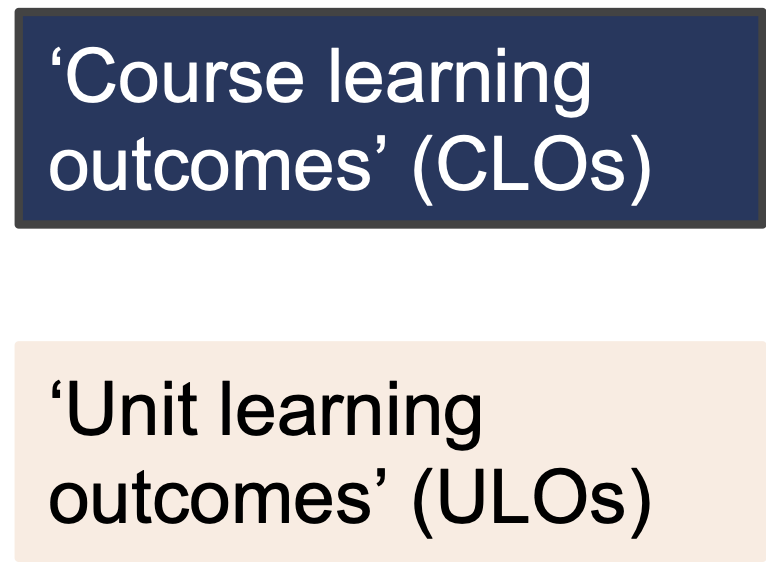
Unit learning outcomes (ULOs) explain how some (or all) of the CLOs and MLOs will be developed in the learning and assessment tasks that the student will undertake in their subject. Guidance on writing ULOs and aligning them to the course outcomes is available. Where a ULO is used to assure a CLO, it must be measurable and assessed securely through either a hurdle task or weighted at 50% or higher. Where it is not used for assurance at the course level, it may be assessed purely through open assessment.
The graduate qualities are the University’s statements on the desired outcomes for every student at the end of their degrees. Their definitions are necessarily broad and abstract. CLOs are course‑level statements that operationalise those aspirations in concrete, assessable and measurable ways. The graduate qualities are usually not directly assessed, measured or assured.
Bachelor and Masters degrees should cover all our graduate qualities and the CLOs for all courses must align with the graduate qualities.
Each CLO (and relevant MLOs) should be introduced, developed, and assured over the length of the course. Curriculum mapping ensures that ”academic judgement of student achievement occurs over time through multiple, coherent, and trustworthy assessment tasks” (Assessment Principle 5 in the Coursework Policy) so that no CLO is left unassessed through secure tasks.
Relationship with the Sydney Assessment Framework
The Sydney Assessment Framework details how the ‘two-lane approach’ assures and develops the knowledge, skills and application described in the CLOs through:
- “Secure” in-person assessment of learning (Lane 1) to measure and assure each outcome and
- “Open” assessment (Lane 2) to help students learn and receive feedback on the disciplinary knowledge, skills, and dispositions described in the outcomes.
Assessment plans
For each course (including embedded degrees) and component, the Learning and Teaching Policy requires the development and approval of an assessment plan mapping learning outcomes to assessment tasks and demonstrating where the learning outcomes are assessed. The plan needs to demonstrate how these tasks assure learning and develop contemporary skills, including the effective use of generative AI.
All CLOs and MLOs must be approved through both the faculty and appropriate Academic Board committees. These are then published in the Handbook. If an existing CLO or MLO is altered, this requires the relevant assessment plans are also re-approved. ULOs are approved at the faculty level but if these changes impact assessment plans – for example if the unit is core to one or more majors – then these need to be re-written and approved.
- The AQF level summaries include statements of the typical achievement of graduates who have been awarded at each level.
- The AQF Second Edition framework contains full descriptors matching each AQL level to the expected knowledge, skills and application using exemplar language.
- See the “What’s next” section directly below for hands-on assistance.
What’s next
- We have trained a Cogniti agent using these resources and model outcomes to assist you in writing CLOs that match the guidelines above, including AQF alignment. This can be used, for example, to help you write outcomes for embedded Grad Cert and Grad Dip degrees within a Masters degree. For assistance in accessing and using this agent, please contact the Division of Teaching and Learning.
Register Now Register for a ‘Writing CLOs that strengthen quality, clarity and integrity’ workshop