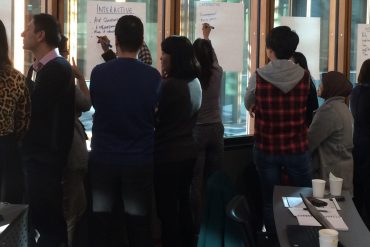

Research on student retention and success consistently shows that the first weeks of semester matter. Research into the student experience of transition, including Kift’s transition pedagogy, articulates the importance of these early weeks in shaping belonging, motivation and persistence.
In this article I outline small moves that support Chinese students’ participation. This piece draws on my research into Chinese international students’ transition experiences, including explaining both why the early weeks of semester matter, and how teachers can use this window deliberately. For many Chinese international students, the opening weeks of their first semester are marked by profound disorientation: a new city, a new campus, a new language of instruction and an unfamiliar set of academic expectations. What teachers do, or don’t do, in this period shapes students’ sense of belonging, their willingness to take academic risks and their long‑term persistence. Early academic welcome is a critical predictor of retention. Small, intentional moves in the first three weeks can shift students’ academic trajectories.
Understanding the transition experience
Kift’s transition pedagogy argues that first‑year success depends on deliberately engaging students’ sense of connection, expectation and purpose. For international students, and in particular those who have previously studied in different academic cultures and languages, transition can involve the reconstruction of identity, of self‑concept as a learner, and of assumptions about what learning is for and how it should happen.
These identity shifts occur within the wider global conditions that shape international students’ self‑formation, described in Marginson’s research on student agency, and are well documented in studies of Confucian heritage culture (CHC) students navigating new academic cultures. Tinto’s model of student integration remains foundational: students who feel academically and socially integrated are significantly more likely to persist. For international students who may lack the informal networks domestic students arrive with, deliberate academic integration is not supplementary but essential.
To pursue this academic welcome, students need to feel that their intellectual contributions are valued. For CHC students managing language demands, cultural adjustment and academic pressure, this sense of intellectual welcome, or its absence, can be decisive. Many CHC students initially interpret teachers through a high‑authority lens, which can heighten perceived risk and delay participation; a relationally invitational stance reduces this barrier and supports what does it support?. These small, intentional moves strengthen learning environments for everyone in the room.
The first class as ‘Welcome!’
Think about your first session the way a good writer thinks about an opening paragraph: it sets the tone, the expectations and the kind of learning community students are entering. If your first class is a walk‑through of the unit outline followed by a discussion about academic integrity the implicit message is that the class is transactional compliance-oriented. If instead the first class is structured around connection, curiosity and expectation‑setting, the message becomes: this is a community of inquiry where your experiences and questions matter.
Signal of welcome include:
- beginning with a genuine question that invites students’ prior knowledge;
- taking a few minutes to ask where students are from and what drew them to the field;
- explicitly naming the learning community you are building.
Students who feel welcomed by their teachers in the first class are far more likely to engage and feel a sense of belonging. For international students who may expect formal, hierarchical interactions, a teacher who is warm, approachable and genuinely curious sends a powerful early signal.
Small moves for teachers
Before the first class – Starting the relationship early
Send a Week 0 welcome email with a one‑page “how this unit works” guide. This reduces uncertainty and lowers cognitive load before classes begin. In this email aim to:
- Use a ‘Getting to know you’ form: A short, optional form inviting students to share learning experiences, expectations and a photo helps you learn names and faces before Week 1 and reduces relational distance for CHC students.
- Provide practical support upfront: Include practical details such as what to bring to the first class, where to find the readings and what Week 1 will involve. Clear, early information reduces anxiety at a moment when both cognitive load and uncertainty are high.
In the first three weeks – create early intellectual connection
Use a short, structured activity in an early class that invites students to engage with an idea in the discipline, not just introduce themselves. This positions students as intellectual agents with curiosity and prior knowledge. Other things to build into the early weeks include:
- Front‑loading expectation‑setting: Many students spend the first month trying to infer what teachers want; a cognitively expensive and often unsuccessful approach. Clearly describe what academic practice in your discipline looks like: how to read critically, what an argument should achieve and how evidence is used. Disciplinary writing and reasoning are socially situated practices that students cannot be expected to infer implicitly.
- Building a low‑risk question culture: Create a “questions board”, physical or digital, from Day 1. For CHC students who may feel that asking questions verbally is too risky early on, this provides a low‑stakes alternative. Address questions at the start of each class to normalise curiosity.
- Making connection a practice, not an event: Check in personally with two or three students per week in the first month. Students who have had at least one genuine one‑to‑one interaction with their teacher early on are significantly more likely to persist.
- Building in an early feedback loop: Use a Week 3 pulse check: What is making sense? What is confusing? What would help?. Communicate this information back to students and tell them about the adjustments you’ll make to help them.
Peer connection as a teaching strategy
For Chinese international students navigating social isolation alongside academic challenge, structured peer connection in the first weeks is core academic support. Early peer relationships provide the social and intellectual scaffolding many students rely on before they feel confident engaging directly with teachers. Assigning study pairs for the first two weeks, using structured small‑group tasks, or facilitating peer introductions in Week 2 accelerates the formation of networks that sustain learning across the semester.
Peer interaction also helps students interpret teacher behaviour and classroom expectations, reducing uncertainty and supporting early participation (Xu and Keevers 2022).