Oral and Maxillofacial Pathology is the study of diseases that affect the teeth, mouth, jaws, and gums, and is one of the core areas knowledge for future dentists. To be capable practitioners, students must blend content knowledge with diagnostic skill; weighing clinical data, histopathology report and often radiographic clues. Supporting students in moving from being recipients of information towards confidently exercising professional judgement is a challenge for any field; in our histopathology tutorial we have developed an approach that blends Socratic questioning and case-based learning, and an AI agent that supports student learning.
Socratic questioning — guiding learners through probing, reflective dialogue — shifts students from passive recipients to active thinkers. As we explored in a previous Teaching@Sydney article on AI-enhanced Socratic teaching, this approach fosters metacognition, deeper engagement, and sharper critical thinking across health professions curricula. Repeated, structured questioning helps students articulate reasoning with more clarity and logic over time. Case-based learning (CBL) complements this by placing students in realistic clinical scenarios that require synthesis of knowledge and reasoning in real time. Meta-analyses across health programs show that CBL significantly improves diagnostic performance, knowledge retention, and learner motivation compared to traditional lectures.
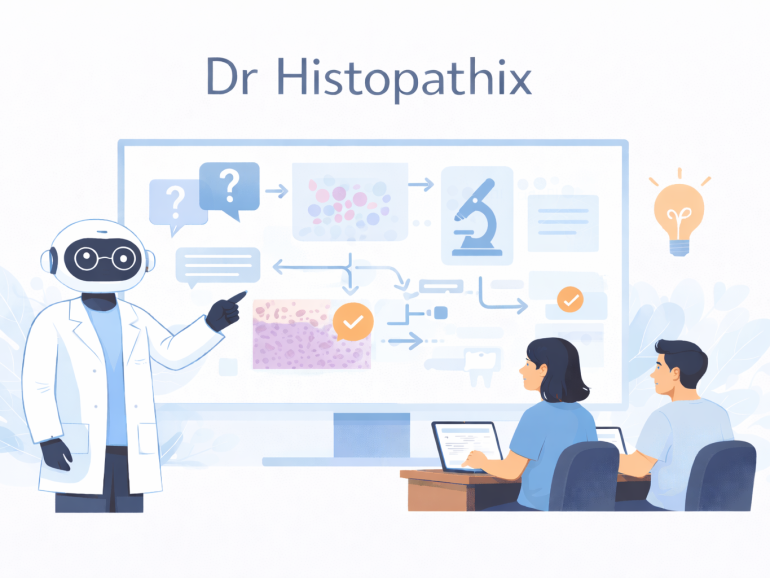
When combined, socratic questioning and CBL create a powerful learning environment. Our generative AI agent Dr Histopathix brings these strategies together, extending them and our capacity as teachers for scalable, personalised learning support.
AI-tailored case scenarios
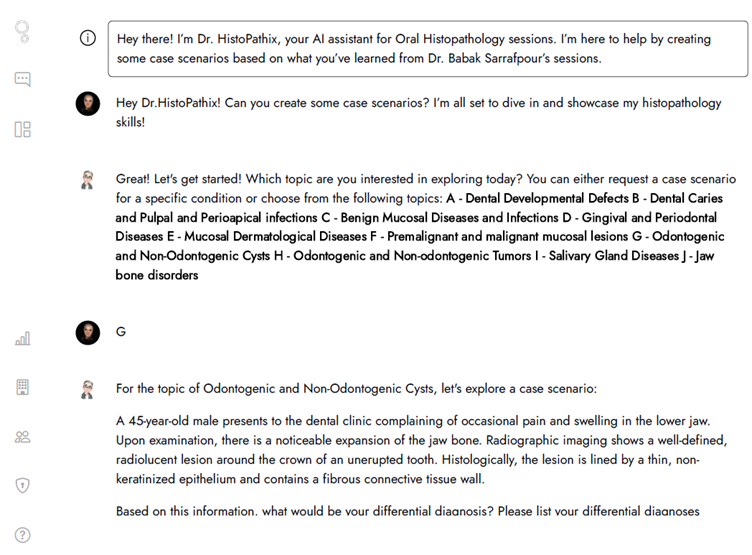
Delivered through Cogniti, Dr Histopathix has been designed to complement oral histopathology practicals for both Doctor of Dental Medicine (DMD) and Bachelor of Oral Health (BOH) students. It generates tailored case scenarios — complete with clinical presentation, histopathological features, and, for specific complicated cases, radiographic descriptions.
Socratic prompts challenge students to observe carefully, interpret findings, and construct differential diagnoses. The tool avoids supplying direct answers, instead it offers guiding clues that nudge learners towards the correct conclusion. Once a diagnosis is reached, Dr Histopathix links to virtual microscopy slides so students can review, compare, and reinforce their understanding.
This approach mirrors research showing that scaffolded reasoning practice through guided questioning leads to measurable gains in analytical clarity, diagnostic logic, and the ability to integrate multimodal evidence.
Creating Dr Histopathix
Dr Histopathix’s Cogniti system message defines its role as a Socratic oral histopathology tutor, guiding students through observation, interpretation, and differential diagnosis using sequenced questions instead of direct answers. It draws on a curated set of oral histopathology teaching resources embedded within Cogniti and through linked Canvas pages, ensuring consistency with course content. Interaction settings favour concise, question-led responses and error-tolerant guidance, and once a provisional diagnosis is reached, the tool directs students to relevant virtual microscopy slides to reinforce integration of reasoning with visual evidence.
Student reflections
While Dr. Histopathix is still relatively new, early student feedback has been very encouraging. Students particularly value how the chatbot supports their clinical reasoning development and strengthens the link between practical class learning and independent study.
“I found Dr. HistoPathix extremely useful in foundational knowledge when it came to Histopathology. What I liked was that it did not give the direct answers but rather, guided you towards figuring it out yourself.”
— Third-year DMD student, 2025
“enjoyed having a tool that you didn’t just need to travel towards the perfect answer with, but could also ask the tool questions to help navigate uncertainty or misinformation that we may have had as new students to the topic.”
— Third-year DMD student, 2025
These comments echo findings in the literature that structured, iterative reasoning practice improves both confidence and performance in diagnostic disciplines.
Teaching reflections and future plans
Dr Histopathix has exhibited particular strengths that link to positive outcomes for students:
- Guiding student reasoning without supplying answers by embedding iterative Socratic questioning — in class or via AI.
- Requiring students to engage in active synthesis and critical interpretation by designing authentic, data-rich cases.
- Encouraging learners to refine their reasoning step-by-step by providing targeted feedback.
- Giving the opportunity for students to compare and consolidate learning across contexts by linking cases to tangible review resources (slides, images, videos)
Planned development aim to deepen engagement, foster comparative reasoning, and prepare students for the complexity of clinical decision-making:
- Expanding the case library to include rare and complex pathologies.
- Designing multimodal cases that blend clinical images, radiographs, and histopathology slides.
- Embedding the tool in formative assessments to monitor reasoning growth over time.
- Extending the approach into related disciplines such as oral medicine, periodontology, and other health sciences.
Developing Dr Histopathix was an iterative process. While the Cogniti platform made it relatively easy to build an initial prototype, refining the prompts so the agent consistently acted as a Socratic tutor, and linking dialogue meaningfully to relevant virtual microscopy images, were more challenging. Ongoing support from the Cogniti team, particularly around platform use and prompt design, was invaluable in aligning the tool with its intended educational purpose.