

Course readings are central to student learning, yet they’re often treated as a routine, grudging task rather than a designed learning experience. On average, only 20-30% of students engage with assigned readings, which impacts class interaction, development of ideas and assessment quality. What does not help is that the complex nature of engagement with course readings is framed as a student-centred issue that rests on individual motivation, preparation or time.
This framing as a student-centred issue misses the point. The significance of course readings extends beyond individual student motivation and reflects a broader design problem involving educators, educational developers and the learning environment we create. When readings are approached as part of a shared and relational process, engagement becomes something we can actively design for rather than simply hope for.
Students bring varied experiences, expectations and anxieties to academic reading. Some rely on summaries, others skim key sections and many ask GenAI to summarise them. These behaviours are understandable when purpose is unclear or when readings are not integrated into the wider course design. When readings are supported with clear structure, visible intent and purposeful interaction, students describe them as useful, manageable and connected to their learning.
This requires attention to what students are being asked to read, how they can engage with the material and why they should engage in this reading. These three lenses underpin the framework introduced below as a basis for designing reading experiences that are active and connected.
Why reading engagement requires design
Engagement with readings is shaped by sociocultural factors, prior experiences and students’ evolving identities as learners. Many navigate academic texts without guidance, using strategies that make sense to them but do not align with unit intentions. When purpose and pathways are unclear, engagement becomes inconsistent and superficial.
Viewing reading as a designed practice opens the way for educators and educational developers to play a more intentional role. Engagement improves when students understand why a reading matters, how it links to weekly learning and what they are expected to do with it. Meaningful engagement was supported through multiple encounters with the text, opportunities to connect ideas with peers and activities that foregrounded purpose.
This design-oriented approach recognises that reading is shaped by relationships, tools and contexts that influence the quality of engagement. When educators design reading activities with clarity and connection in mind, students are better positioned to engage with ideas in sustained ways.
A framework for meaningful engagement
The framework brings together six dimensions that help educators design purposeful, relational engagement with course readings. These dimensions operate as an entangled assemblage rather than discrete elements and draw on the lenses of what, how and why.
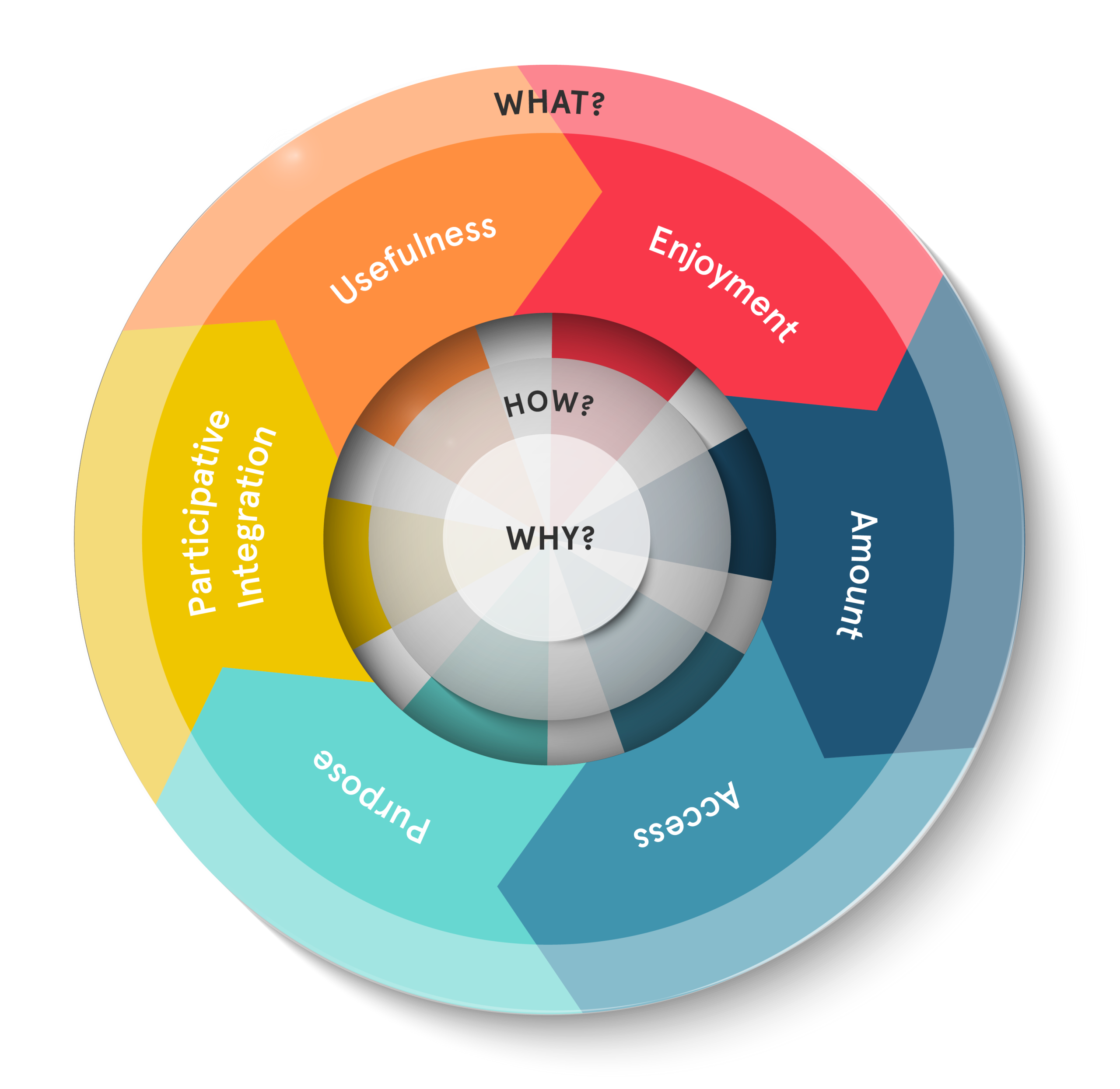
- Usefulness.
Students engaged when the reading helped them understand concepts, interpret scenarios or appeared practical. Usefulness arises when relevance is visible and when students can see how ideas contribute to their learning. - Enjoyment.
Enjoyment reflects curiosity, interest and meaningful learning. It is supported when reading is connected to purposeful activity, peer interaction or design features that help students (safely) make sense of ideas. - Quantity.
The amount of reading should be responsive to purpose. Some weeks may call for full texts, while others may benefit from selected sections or alternative formats, e.g. YouTube, podcasts, social media or GenAI. - Access.
Ease of access influenced engagement. Stable links, clear navigation and high-quality text reduced barriers, especially for students managing heavy workloads or new to academic reading. - Intent.
Students wanted clarity on why to read a particular text and how it supported their learning. Making intent explicit strengthened their capacity to engage with purpose and connect readings with activities and assessments. - Participative integration.
This dimension highlights the need to integrate readings into active learning. Structured prompts, guided discussions and opportunities to revisit ideas supported deeper engagement. Participative integration can include engagement with generative AI, e.g. comparing an AI-generated summary to the original text or critiquing AI interpretations.
An example of the framework in action
Here is one example of what this framework looks like in practice. The framework was used in a large postgraduate unit in a Business School, where weekly readings were redesigned as part of the learning experience rather than treated as background preparation.
Each week, students were first given 1-2 “must-read” pages from a longer article, displayed directly in Canvas. These pages introduced the key idea for the week and helped students focus on what mattered most. Below the excerpt, students responded to a short discussion prompt that asked them to connect the reading to a weekly question or scenario. This made it clear why the reading mattered and what students were expected to do with it. Students could then choose to read the full article via the library link if they wanted to explore the ideas in more depth.
Students described this structure as helping them read with purpose rather than feeling overwhelmed. Students noted that the reading was “easy to understand” and “related back to the course content very well” (Student survey 2021), while the unit coordinator explained that having a guiding question meant they were not “just reading for the sake of reading” (Course coordinator interview 2021). Several students also described going back to the full article after reading their peers’ responses, suggesting that clearer structure and intent supported deeper engagement over time.
Final reflections
Designing meaningful engagement with course readings involves creating opportunities for students to participate with ideas, connect with others and understand why the reading matters. The six-dimension design framework provides a practical structure for educators and educational developers to support purposeful engagement with course readings.