
Back in 2023, in the article Unravelling the teaching-research nexus, I explored one of higher education’s most enduring assumptions: that teaching and research naturally inform and enhance one another. As detailed there, the evidence from decades of studies paints a more complicated picture (Hattie and Marsh, 1996, 2002 and 2004; McKinley et al. 2019). It shows little or no relationship between research and teaching quality at the level of individuals, departments or institutions.
This conclusion has prompted considerable discussion. Some see it as a challenge to a cherished idea and others challenge the evidence. Many, though, recognise their own experience as both academics and students in the evidence. Most academics can point to colleagues who inspire students through brilliantly integrating research and teaching. I certainly sat through many uninspiring lectures where professors talked about their research. Many of us though can also trace our own choices and development to educators and researchers who invited us into the questions, methods and excitement of knowledge creation. In my own case, I can remember choosing to pursue a PhD during a term at Oxford when the college tutor helped us to understand and predict how electrons interact in novel magnetic materials he was developing.
Artificial intelligence gives this question new urgency. Emerging technologies are reshaping how knowledge is created and transforming the world of work. AI is not only changing how knowledge is accessed and communicated – it is increasingly changing how research itself is conducted, from literature discovery and data analysis through to hypothesis generation and experimentation. In this article, I argue that the teaching-research nexus is becoming more important, not less, because it helps develop the human capabilities that graduates need in an age of AI.
For much of our history, universities could justify their role in both research and education through access to knowledge. Researchers generate new knowledge and educators transmit it. Students learn from scholars working at the frontier of their disciplines. The emergence of AI has, of course, accelerated the reality that knowledge is no longer scarce. Students can generate explanations, summaries, code, analyses, compose and draw and provide increasingly sophisticated and convincing responses to complex questions in seconds. Access to information is no longer the challenge but evaluation, judgement and discernment certainly are – and it becomes more important to engage students with authentic, and often ill-structured, research questions in the discipline as well.
How do we know whether a claim is trustworthy? How do we evaluate evidence? How do we identify limitations, biases and assumptions? How do we decide what matters, what is reliable, and what should be done next? These are fundamentally research questions and ones that the humans need to be adept at asking.
This is one reason why AI presents an unexpected opportunity and obligation on universities. Rather than making the teaching-research nexus less relevant, it may help us rediscover how research enriches learning and how teaching connects research to society.
Access to information is no longer the challenge but evaluation, judgement and discernment certainly are.
The nexus remains just an aspiration
Before asking what the teaching-research nexus should become, it is worth briefly revisiting why the question matters. Despite its central place in academic culture and in the regulatory definition of the university, the evidence for a direct relationship between research performance and teaching quality remains remarkably weak. As outlined in Unravelling the teaching-research nexus, analysis and meta-analyses of decades of studies have found little or no correlation between the two at the level of individual academics, departments or institutions. More importantly, this finding appears remarkably stable across disciplines, levels of study and institutional contexts.
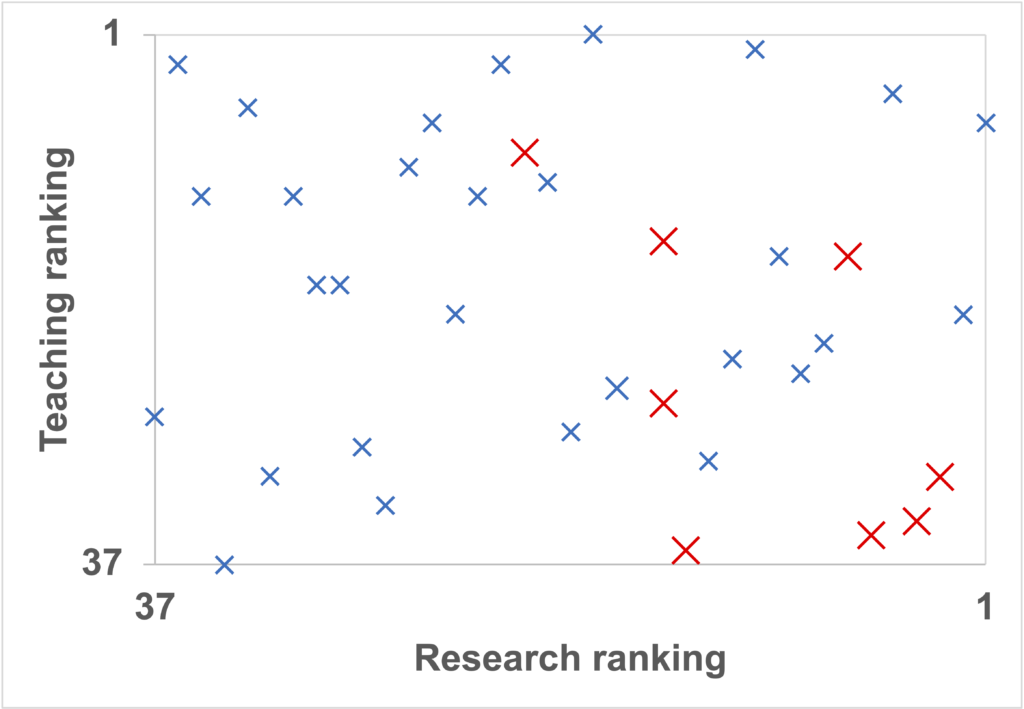
The figure below refreshes a quick analysis from the earlier article using publicly available contemporary data to compare institutional rankings of research quality with measures of student perceptions of teaching quality. The figure looks much the same if the results for any discipline are used – which readers can verify for themselves. The result has not changed. Universities with stronger research performance did not consistently achieve stronger student perceptions of teaching quality, including within individual disciplines. As noted earlier, there is no correlation and so there is equally no suggestion that strong research leads to poor teaching or vice versa.
This does not mean that research and teaching are unrelated. It does not mean that excellent researchers cannot be excellent teachers. However, it does suggest that the nexus does not emerge automatically simply because both activities occur within the same institution. For teaching and research to be positively related, the nexus must be deliberately designed into our teaching and research practices. AI makes that design challenge impossible to ignore.
Graduate capabilities in an age of knowledge abundance
For much of their history, universities occupied a privileged position in society because they were among the few places where knowledge was created, curated and taught. In an era of information scarcity, this role was enormously valuable. The challenge now is no longer finding information or producing convincing answers. It is deciding whether those answers are any good:
- Is the argument correct?
- Is the evidence reliable?
- What assumptions have been made?
- What has been overlooked?
These are questions about evidence, judgement, uncertainty and validation, rather than knowledge acquisition, and we normally associate them with research.
The recently released Castlereagh Statement argues that education systems designed for an era of information scarcity must increasingly focus on the capabilities needed in a world where information and cognitive labour are abundant. It highlights curiosity, discernment, creativity, collaboration, courage and learning how to learn as enduring human capabilities that should sit at the centre of educational design. Seen like that, the most valuable contribution of research may be the methods, habits of mind and ways of working that it develops.
Research-led learning
Many efforts to strengthen the teaching-research nexus focus primarily on research-led teaching exposing students to current research. Educators share recent discoveries in lectures and set students journal articles to read. New findings are incorporated into teaching materials and curricula. Such exposure to research is important, but it is not the same as experiencing research or developing research capability.
Research is not simply a body of knowledge. Every discipline has distinctive ways of asking questions, gathering evidence, evaluating competing explanations, challenging assumptions, navigating uncertainty and constructing new understanding. The strongest forms of the teaching-research nexus occur when students actively participate in those processes:
- In science and engineering, this may involve reproducing or extending published findings. In health professions, students may learn to make decisions where the evidence is incomplete, contested or evolving.
- In the humanities, it may involve analysing competing interpretations and constructing arguments.
- In business and economics, it may involve investigating real organisational problems using contemporary data.
- In computing and data science, it increasingly involves evaluating AI-generated solutions, interrogating assumptions, testing outputs and understanding the limitations of automated systems.
Although each discipline approaches inquiry differently, the common thread is participation in knowledge creation. How can our students can also be co-producers of new knowledge in our disciplines. This distinction has become increasingly important in the age of AI.
Recent OECD reports on AI and education, listed in ‘Further reading’ below, suggest that performing a task with AI is not the same as learning. Students may produce sophisticated outputs while bypassing the cognitive processes required to develop expertise. The OECD notes that AI-assisted performance can create an illusion of competence. Students may appear highly capable while significant gaps in understanding remain hidden. In their report on the effective use of AI in education, the OECD also describes the risk of “metacognitive laziness”, where learners avoid the intellectual struggle through which understanding develops.
For decades, higher education has relied on essays, reports, examination answers and presentations as evidence of learning. Increasingly, AI allows students to generate polished and convincing outputs without necessarily developing the underlying capabilities those outputs were designed to assess. The OECD therefore argues that education should place greater emphasis on learning processes rather than final products. Students need opportunities to explain their thinking, evaluate evidence, justify decisions, revise ideas and reflect on how their understanding has changed. Learning must become more visible.
Importantly, the OECD does not argue that foundational knowledge has become less important. Students need strong disciplinary knowledge to evaluate AI-generated responses, identify errors, recognise limitations and exercise judgement. At the same time, the OECD argues that capabilities such as creativity, judgement, collaboration, adaptability and lifelong learning are becoming increasingly valuable as AI capability grows.
This mirrors the shift proposed in the Castlereagh Statement, which calls for education systems to place greater emphasis on curiosity, discernment, creativity, collaboration, courage and learning how to learn.
Viewed through this lens, the teaching-research nexus takes on new significance. Research naturally combines deep disciplinary knowledge with curiosity, judgement, creativity, collaboration and learning through uncertainty. Researchers formulate questions, evaluate evidence, test assumptions, interrogate alternative explanations and refine their thinking through critique. These are precisely the capabilities and learning processes that both the OECD and the Castlereagh Statement suggest will become increasingly important in an AI-enabled future.
The future value of the teaching-research nexus increasingly lies less in giving students greater exposure to research findings and more in giving them experience of the processes through which knowledge itself is created, challenged and improved.
What should students learn from research?
Aligning closely with the first principle of the Castlereagh Statement, which calls for education to cultivate the enduring human capabilities and dispositions that remain valuable as technologies grow ever more powerful, research-led learning develops:
- Curiosity: The capacity to identify important questions, explore unfamiliar domains and challenge assumptions. Research and innovation begin with curiosity in every discipline.
- Discernment and judgement: The ability to “sift through slop”, evaluate evidence, interrogate claims, recognise limitations and exercise judgement about what should be trusted.
- Creativity: The ability to generate novel ideas, combine concepts across disciplines and design solutions that do not yet exist.
- Collaboration: The ability to work effectively in diverse teams and with technologies to address complex problems. Our students are inheriting a world with wicked problems and challenges which collaboration across disciplines, professions, perspectives and countries.
- Courage: The willingness to engage with ambiguity, uncertainty and problems that have no predetermined solution.
- Learning agility: The ability to continually acquire new knowledge, adapt to changing contexts and learn how to learn, unlearn and relearn.
These are not simply the attributes of successful researchers. They are increasingly the attributes of successful graduates. Many academics, myself included, became excited by research because of exposure to both research findings during our undergraduate days and to research projects in honours or postgraduate study. The evidence suggests that this is not a common experience for the majority of our graduates. There are at least four institutional levers that we can use to change this:
- Curriculum: Students need opportunities to engage in inquiry and investigation from first year throughout their degrees, not only in honours projects or postgraduate research. Research experiences should be scaffolded across programs, moving progressively from guided inquiry towards increasingly open-ended investigation.
- Assessment: Assessment will remain one of the most powerful influences on student behaviour. If students are rewarded for reproducing information, they will optimise for reproduction. If they are rewarded for evaluation, experimentation, reflection, critique, creation and building on failure, they will develop the capabilities associated with both research and professional practice.
- Educator capability: Designing inquiry-rich learning environments, facilitating investigation, teaching judgement, creating authentic assessment and supporting learning in technology-rich contexts are sophisticated educational capabilities that require educators to deliberately turn their research skills into student-centric practice.
- Recognition and reward: If institutions value the integration of teaching and research then they must have equal status, and appointment and promotion systems, workload models and recognition frameworks need to reward academics who successfully create those connections for students.
A nexus that works both ways
In most discussions of the teaching-research nexus, it is often framed as a way of bringing research into teaching. The connection though should work in both directions. Teaching challenges researchers to explain why their work matters, communicate complex ideas clearly and connect specialised knowledge to broader human questions.
In an age of AI, this is increasingly important. As technologies transform society, researchers cannot assume that the value, risks or implications of their work are self-evident. Public understanding, trust and informed debate depend on researchers being able to explain not only what they have discovered but why it matters. This aligns with the Castlereagh Statement’s emphasis on trust, discernment and ensuring that technology serves society rather than the reverse.
Teaching also reminds researchers who ultimately benefits from their work.
Teaching also reminds researchers who ultimately benefits from their work. Through our students, we are constantly confronted with future generations and the social, environmental and economic challenges they will inherit. The questions students ask can help ensure that research remains connected to public purpose rather than disciplinary curiosity alone.
Teaching occurs both in and out of formal classrooms and provides one of the most important mechanisms through which universities remain connected to society. Through our students, research ideas move beyond journals and laboratories into organisations, professions, communities and public life. Through the mainstream and social media, our research has the potential to combat fake news and build trust.
Rediscovering the nexus
Research enriches learning by exposing students to inquiry and knowledge creation. Teaching enriches research by encouraging communication, reflection and accountability to the communities that universities serve. It also reminds researchers that the ultimate purpose of knowledge creation is not simply publication, citations or even discovery, but contributing to a better future. A healthy teaching-research nexus strengthens both educational and social impact.
The capabilities developed through research are increasingly the capabilities required for employability and flourishing in an AI-enabled world. Researchers are, fundamentally, professional learners. They continuously acquire new knowledge, often fail more than they succeed, adapt to emerging evidence, abandon ideas that no longer fit the data and develop new ways of understanding the world. As current AI technologies advance further and new ones emerge, it is this ability to learn, unlearn and relearn that should define all graduates and not just those who follow our steps into research.
Further Reading
- The Castlereagh Statement (2026). Retrieved from https://castlereagh.ai/.
- OECD (2023). OECD Digital Education Outlook 2023. OECD Publishing, Paris. Retrieved from https://www.oecd.org/en/publications/2023/12/oecd-digital-education-outlook-2023_c827b81a.html.
- OECD (2024). AI and the Future of Skills, Volume 2. OECD Publishing, Paris. Retrieved from https://www.oecd.org/en/publications/ai-and-the-future-of-skills-volume-2_a9fe53cb-en.html.
- OECD (2026). OECD Digital Education Outlook 2026: Exploring Effective Uses of Generative AI in Education. OECD Publishing, Paris. Retrieved from https://www.oecd.org/en/publications/oecd-digital-education-outlook-2026_062a7394-en.html.
- Jobs and Skills Australia (2025). Our Gen AI Transition: Implications for Work and Skills. Australian Government. Retrieved from https://www.jobsandskills.gov.au/publications/generative-ai-capacity-study-report.
- Hattie, J., & Marsh, H. W. (1996). The Relationship Between Research and Teaching: A Meta-Analysis. Review of Educational Research, 66(4), 507–542. Retrieved from https://doi.org/10.3102/00346543066004507
- Hattie J. & Marsh H. W. (2004). One journey to unravel the relationship between research and teaching. Paper presented at Research and Teaching: Closing the Divide? An International Colloquium, Winchester, March 18-19. Retrieved from https://www.researchgate.net/publication/251600109_One_journey_to_unravel_the_relationship_between_research_and_teaching
- Marsh, H. W., & Hattie, J. (2002). The relation between research productivity and teaching effectiveness: Complementary, antagonistic, or independent constructs?. The Journal of Higher Education, 73(5), 603-641. Retrieved from https://doi.org/10.1080/00221546.2002.11777170
- McKinley, J., Harris, A., Jones, M., McIntosh, S., & Milligan, L. (2019). An Exploration of the Teaching-Research Nexus in Humanities and Social Sciences in Higher Education. London: British Academy. Retrieved from https://www.thebritishacademy.ac.uk/documents/4094/McKinley-et-al-An-Exploration-of-the-Teaching-Research-Nexus.pdf