
What does it mean to design assessments to be inclusive, valid and fair? Why does it matter? Whose responsibility is it? How do we do it?
Held throughout Disability Inclusion Month, our Universal Design for Learning (UDL) Masterclass series answered these questions and more. UDL is an evidence-informed framework that guides the proactive design of inclusive teaching and learning for all students (CAST, 2024). It is being widely adopted in response to findings on persistent inequities for underrepresented student groups in the Australian Universities Accord (Morris, R., Hitches, E. 2026). UDL will feature prominently in the University of Sydney’s new 2026 Disability Inclusion Action Plan (DIAP) to ensure curriculum and learning are accessible by design. Adopting a universal design approach is one way we can ensure assessment practices are inclusive, valid and fair in line with Coursework Policy Assessment Principle 3.
Student perspective
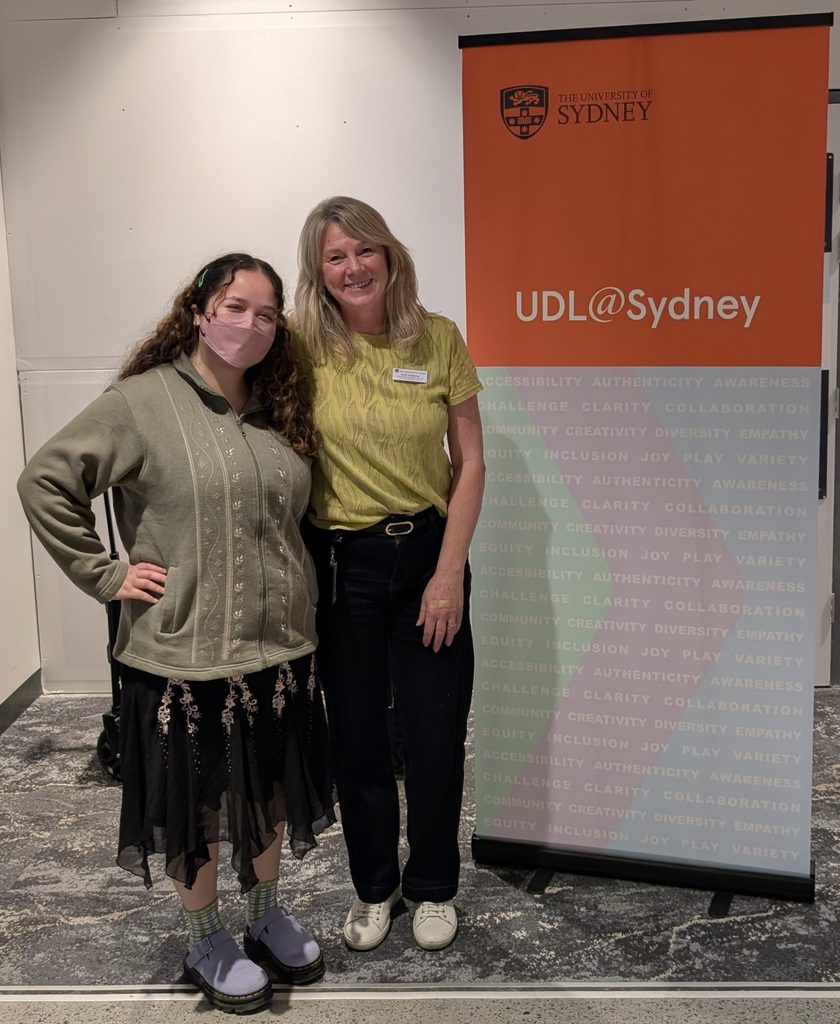
At our first UDL masterclass: The Policy Landscape, Kayla Hill, Disability Officer with the Student Representative Council (SRC), set the tone for why inclusion matters by sharing the experiences of students with disability at Sydney, including her own:
…to be perfectly candid, I would not be here at this point in my degree were it not for the luck of having kind teachers and mostly lenient assessments.
Inclusion left to chance increases the stress and burden of self-advocacy, requires students to jump over a lot of hurdles, and further disadvantages the individual.
A common misconception in education is that treating every student exactly the same creates fairness. In practice, however, learners bring different backgrounds, strengths, challenges, and preferences to the learning environment. A one-size-fits-all approach rarely serves everyone well. The reality for our students, according to Kayla, is that:
…poor design, inaccessible design, excludes us from achieving these academic outcomes.
Drawing on both her own experience and her work as SRC Disability Officer, Kayla highlighted how barriers in curriculum and assessment design can increase reliance on individual adjustments and self-advocacy, advocating instead for “a baseline that is best for all students (that) maximises equity” through proactive design.
Inclusive assessment design
So what does it mean to design assessments to be inclusive, valid and fair? Let’s start by unpacking each term:
- Inclusive assessment is intentionally designed to enable all students, to the greatest extent possible, to participate and demonstrate learning. It reduces barriers through flexible and accessible approaches and minimises the need for individual adjustments.
- Valid assessment measures the intended learning outcomes. It is aligned to the content taught and ensures that judgements reflect relevant knowledge and skills, without being influenced by construct-irrelevant factors.
- Fair assessment ensures equitable opportunity for all students to demonstrate achievement, and may include individual adjustments.
With these definitions in mind, we can now think about how we do it. This is where Universal Design for Learning comes in – the UDL framework guides us to think about how we can design for diversity and intentionally include all learners from the start and not leave it up to luck, as Kayla described. By reducing construct-irrelevant barriers while maintaining alignment with learning outcomes, UDL helps ensure that assessment outcomes reflect what students know and can do, rather than how well they navigate avoidable obstacles. Recognising that these barriers exist within the learning environment, rather than within our students, is the first step.
In Session 2: Stories of impact, educators from Sydney School of Veterinary Science, Faculty of Medicine and Health, Faculty of Arts and Social Sciences, and Faculty of Science shared examples of their processes in using UDL guidelines to design diverse, creative, and authentic assessments. These stories are captured on our UDL@Sydney Canvas site and highlight how UDL can support educators to “take appropriate steps to ensure all teaching materials and delivery methods create safe and inclusive spaces that respect a diversity of students and staff” (Academic Excellence Framework, Education Pillar).
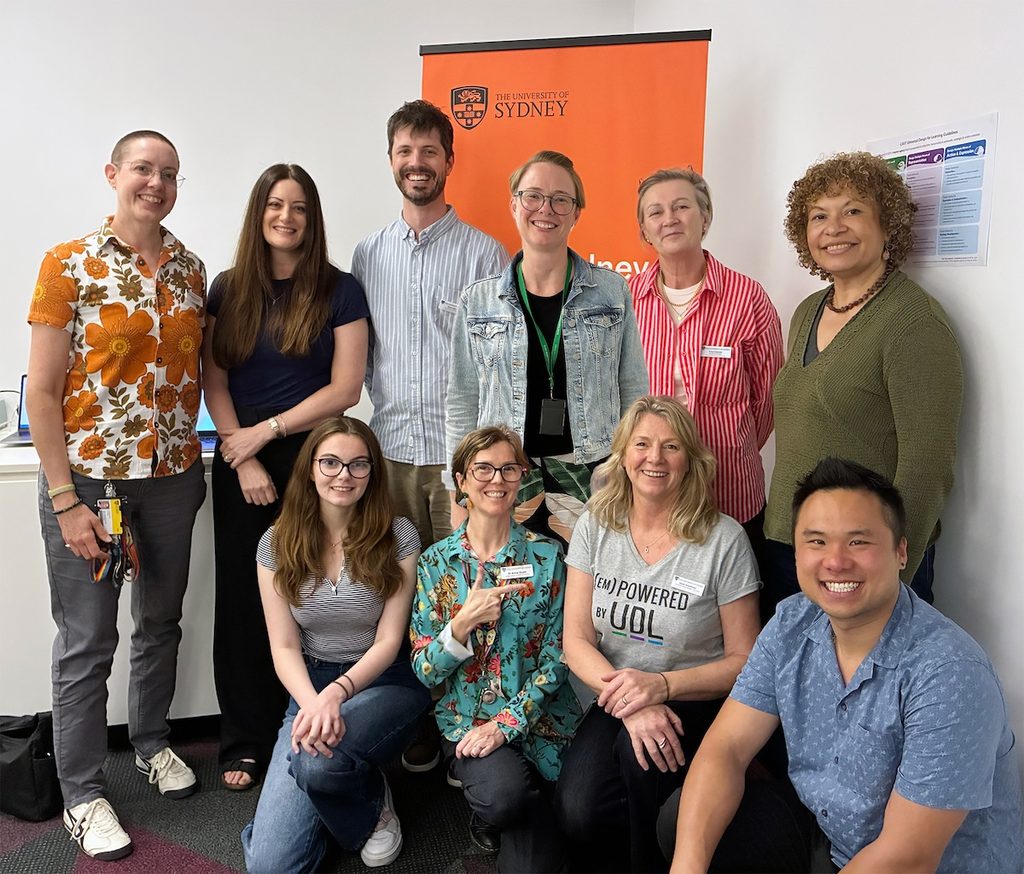
Front row: Rose Palmer (Student partner), Anne Quain (APLD**, SSVS), Sarah Humphreys (DTL), Mike Widjaja (SOLES)
Tips for applying UDL to assessment design
In Session 3: Collaborative workshop, students, academics and professional staff engaged in a day of sharing, learning and productive conversation. A consistent message throughout the day was that barriers exist in the environment, not the student. By shifting our focus in this way, and by working collaboratively with students and colleagues, we can start to systematically improve assessment design. This discussion highlighted three practical ways to apply UDL to assessment design:
- Identify barriers that may exist in the assessment design, not the student
- Anticipate the options and/or supports diverse learners may need to demonstrate achievement of the learning outcomes
- Proactively build these options and supports into the design of the assessment
Common barriers in assessment design and UDL approaches to remove them
| Assessment component | Common barriers | UDL approach to remove barrier |
| Alignment with unit outline | Inconsistencies in titles, descriptions, modes and weightings – leads to confusion and misunderstanding of the task. | Align core assessment information across platforms to give clarity and equitable access. |
| Instructions | Scattered information across multiple Canvas pages and in linked documents – difficult to find and risks being inaccurate. | All assessment information located under the Assignments tab in the left-hand menu Canvas, with assessment details entered on a Canvas page. |
| Due dates | Extensions or adjustments not updated in Canvas – results in ‘overdue’ warning message and late penalties mistakenly applied. | Check due dates in Canvas align with the unit outline. Any changes to due dates, including for extensions and adjustments, are updated in the Canvas assignment settings. |
| Quiz settings | Timed quizzes and capped attempts – increase stress, may require adjustments. | Extend or remove time limits and allow multiple attempts. |
| Assessment mode | Assessments that prescribe a single mode, unrelated to the learning outcomes. | Offer a choice of modes for students to select from, aligned to a single rubric. |
| Rubrics | Missing or mark-only rubrics; rubrics lacking guidance on requirements and standards; or containing requirements unrelated to the learning outcomes. | Provide a rubric with clear descriptions that guide learners to understand expectations and how to demonstrate success. |
Evidencing success
The final session in the UDL Masterclass Series covered ways for educators to demonstrate achievement in inclusive practice within the Academic Excellence Framework, build scholarship of teaching and learning (SOTL), and strengthen applications for awards, promotion, or Advance HE Fellowship. The discussions highlighted diverse ways to evidence practice, including using the Designing for Diversity process, and the potential to evidence practice in ways that allow educators to leverage their UDL design projects in multiple pathways. We were also grateful for the insights provided by student partners who attended and contributed their vital perspectives, including affirming the value of the relational aspects of education to facilitate dialogue and feedback to enhance practice.
UDL support and resources
Visit our UDL@Sydney Canvas site anytime where we continue to add resources from the series, along with stories of impact, links to UDL workshops, design intensives, and monthly UDLchat.
Ensuring assessment practices are inclusive, valid and fair is everyone’s responsibility and is a shared endeavour. Bringing people together to share their expertise from across the University has been a key feature of the UDL Masterclass Series: Designing Assessments to be inclusive, valid and fair. This series was presented by the Division of Teaching and Learning in collaboration with students, academic and professional colleagues from across the University. It forms part of a larger project,‘Using UDL for building capability and community in higher education’, supported by a University of Sydney Seed and Scale Developing Practice Grant awarded by the Community and Leadership Portfolio.
The next event within the project is our Career development series: Championing UDL in the Third Space which begins on 20 October 2026. Register for the sessions:
- Session 1: Influencing: how we build buy-in with international UDL expert Dr Lillian Nave from Appalachian State University (20 Oct)
- Session 2: Partnering: how we work across communities to embed UDL – panel discussion led by Sarah Humphreys, Division of Teaching Learning, University of Sydney (21 Oct)
- Session 3: Evaluating: how we demonstrate impact and sustain change with international UDL expert Dr Kavita Rao from the University of Hawaii. (22 Oct)
Other support
- Academic Plan Lead – Disability (APLD) roles providing leadership within the Faculty/School in respect to matters relating to student with disability.
- Digital Accessibility for content creators – a self-paced module on how to make information accessible to people with disabilities
- Equity in Motion – Canvas resource to promote understanding of Inclusion and Disability Services
- UDL Tips for Assessment, CAST 2024
*IDS = Inclusion and Disability Services
**APLD=Academic Plan Lead Disability