
Recent challenges with open written assessments
There has been an understandable focus on secure assessments lately, but not all assessments can be secured, and this presents challenges for written assessments. While working with the allowance of AI in ‘open’ assessments, it is a fraught business to discern the provenance of the writing itself, but integrity must be upheld, and this is intrinsically bound up in the demonstration of a conscientious research process (the proverbial ‘iceberg’ that should be discernible beneath the citational ‘tips’ in a submitted paper). As Young No has discussed, the key academic skill is not coaching students to produce better references (where the functional transparency of integrity is often confused as a technical aesthetic), but coaching students to use evidence in a responsible way, showing how they have verified and evaluated the connections they are discussing.
Key issues in written assessments concern the rise of faux citations that vaguely allude to sources without citing specific information, and inaccurate citations where incorrect page numbers are provided or “quotations” are seemingly invented or are paraphrases presented as “quotations”. There are also “hallucinations”, where a whole reference appears not only to have been invented and inserted in the reference list, but cited and sometimes “quoted” throughout the paper. Where such foibles and oversights are widespread in open written assessments, it suggests that many students are avoiding reading sources altogether, despite AI’s promise to economise the writing process which would notionally reserve more time for deeper studies.
When working with open assessments as tasks that specifically allow AI (because it would be impossible to restrict it), Corbin, Dawson, and Liu (2025) argue that rule-based guardrails alone can produce an “enforcement illusion” (pp. 1087-1088), and propose instead that a structural redesign of assessments is needed to help better assure that learning outcomes are being met. Gray et al. (2025) propose that rather than punitive policing of students’ uses of AI, assessments should be restructured with an aim to:
- enrich the assessment purpose
- promote self-efficacy
- increase the perceived cost of diverting one’s learning (p. 2075).
Guided by these principles, we implemented an adaptation to our assessments by requiring students to append screenshots for every cited passage in their essays, promoting transparency and pride in careful research. This approach of using Demonstrative Research Papers (DRPs) was introduced in Semester 2 2025, with support from a SACE Education Grant. Students were asked to bank screenshots in an Appendix at the bottom of their essays, so the core essay task remained the same, but the coherency of orchestrating their ideas and scholarship could be observed, allowing tutors to provide more meaningful support and feedback. These DRPs could therefore be adapted to any existing written task without the need to change details in a published unit outline.
Implementing Demonstrative Research Papers
The DRPs were implemented in a postgraduate Professional Writing unit with 420 enrolments after census, comprising a diverse cohort with over 90% international students. Three written assessments were scheduled:
- 1,000 word, rhetorical analysis (25%)
- 2,500 word, group written task (50%)
- 1,000 word, proposal task (25%)
The DRP was applied to the first two tasks but not the third, because the third required students to work with track-changes and we thought requesting a second metatextual component would prove overly perplexing. And yet, according to feedback from tutors and our student survey, many students still chose to include screenshots for the third assignment to continue displaying their research, suggesting that the DRP requirement was cultivating self-efficacy principles.
What did students do?
Students completed the written task as usual but appended a series of screenshots for every cited passage using drawing tools to highlight or underline the precise details cited. This does not take much time if students have their research on their screens and are citing diligently, but it can prove time-consuming if students had not completed readings or were trying to locate passages cited by AI in their drafts (thus prompting a post factum self-editing process). This structural intervention thus conformed with recommendations: by enriching the assessment purpose, promoting self-efficacy, and highlighting the perceived costs of diverting one’s learning.
Students were provided with research materials in Canvas and completed exercises in tutorials to further scaffold the task. Overall, the DRPs resulted in far greater demonstrated accuracy in citational practices across the cohort and greater perspicuity in observing lax citational practices. The DRPs appeared to shift student understandings of citational practice from an aesthetic appreciation to a more functional appreciation of the ethical requirement for transparent research.
Exemplars
Below are two examples of student’s DRPs, published with permission by the students.
- Student essay exemplar (Triple J)
- Student essay exemplar (gender equality),
- 2025 DRP marking rubric.
Student feedback
Our team conducted an in-class anonymous Qualtrics survey to gain feedback from students. An ethics exemption to use this ‘low risk’ data in publications was obtained. We received 224 responses from 420 students (53%), which reduced to 180 responses (43%) when non-consenting students and ‘bot’ submissions were filtered out. The data shows a strong endorsement of DRPs:
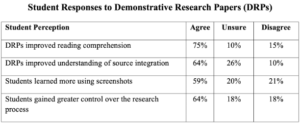
While our open-ended survey questions received many comments of praise for DRPs, a more interesting result emerged from students who disliked the task but still acknowledged its merits. These comments were provided under a question about what students didn’t like about DRPs:
- “It is useful but sometimes it is annoying.”
- “Tedious… but a great idea.”
- “DRP forced me to use fewer sources-more close readings”
- “This pushed me to read references carefully…”
- “It really doubled my time… but I just feel more logical.”
It should be stressed that banking screenshots is a quick metatextual task when the materials are in front of you, but it may become time consuming when materials have not been properly processed or are vaguely sourced.
Teaching team reflections
Because sessional teachers deliver the bulk of teaching and marking at university (Woeler et al., 2025, 34), their feedback is essential, especially regarding open assessments. Tutors observed some initial confusion by students, with screenshots seen as “just another task” (DX) or prompting the unexpected anxiety of “exposing issues in [student] comprehension skills” (AN). Yet the initial uncertainty evolved into acceptance and then enthusiasm. SR reported highlighted screenshots “built a sense of trust” with the marker, and LSR found students were “intrigued and… excited about the DRPs.” AL noted “closely integrated work stood out more clearly”, while DX observed that screenshots made it “simpler to spot” vague or AI-generated foibles. JL found the DRPs helped to “demystify academic research” for the cohort. Collectively, tutors observed improvements in research literacy and academic integrity, with a rise in student confidence with scholarly writing-especially when research techniques could be scaffolded.
Contacts
We welcome any questions about the DRPs: [email protected]
References
Corbin, T., Dawson, P., & Liu, D. (2025). Talk is cheap: why structural assessment changes are needed for a time of GenAI. Assessment & Evaluation in Higher Education 50(7), 1087-1097. https://doi.org/10.1080/02602938.2025.2503964
Leaton Gray, S., Edsall, D., & Parapadakis, D. (2025). AI-based digital cheating at university, and the case for new ethical pedagogies. Journal of Academic Ethics 23, 2069-2086.
https://doi.org/10.1007/s10805-025-09642-y
Woelert, P., Croucher, G., & Hoang, S. (2026). The rise of a “casualised” workforce: A conceptual account of the institutional forces legitimising contingent academic employment in Australia. Higher Education, 91, 23-38. https://doi.org/10.1007/s10734-025-01405-3