
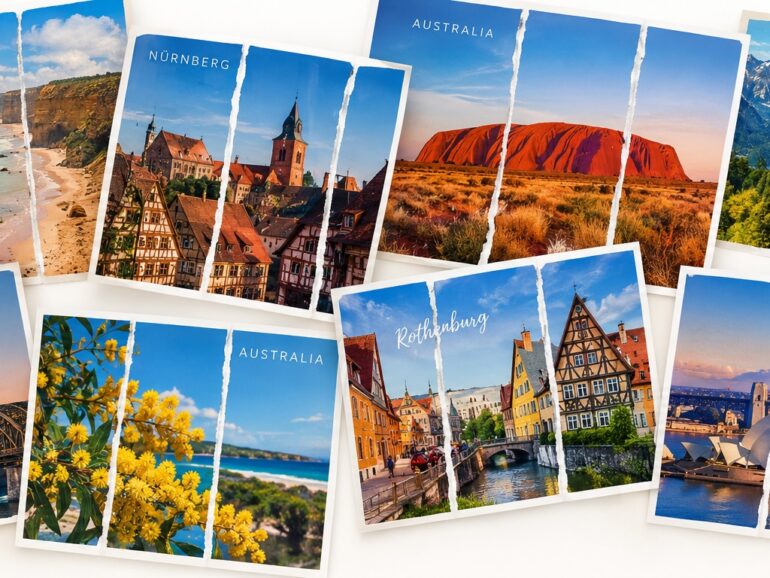
What can a postcard teach us? At first glance, perhaps not very much. A small piece of card, usually with a picture on one side and a few lines of writing on the other, may seem almost old fashioned in an age of instant messaging, social media and GenAI. Yet when I bring postcards into my German classes, I am reminded that their simplicity is precisely what makes them useful. A postcard can become a prompt for conversation, a writing space, a source for interpretation, a historical document or a piece of visual culture. For me, the pedagogical value of the postcard lies in this versatility.
From postcard to pedagogy
Postcards emerged as an inexpensive alternative to letters and became an important form of mass communication in the late nineteenth and early twentieth centuries. With the rise of the picture postcard, the medium also became increasingly visual. During the Golden Age of the postcard, from the late 1890s to the end of the First World War, postcards gained popularity as a medium for communication, photography, advertising, tourism and collecting.
Australia was part of this development. Picture postcards became very popular in the early twentieth century, serving as souvenirs and an inexpensive way to communicate, while their images and messages captured places, events and aspects of everyday life. Australia Post dates the postcard boom to 1900-1920, noting their use for messages, souvenirs and commemorating significant events.
The postcard therefore sits at an interesting intersection of text and image, communication and memory, the personal and the public. These characteristics make it productive for teaching.
Cards, café and classrooms
There is also a practical reason why I like working with postcards: They can be remarkably easy to obtain. They can be found in cafés, restaurants, cultural venues and public spaces, as well as on university campuses. Students may encounter them while having a coffee, waiting between classes or walking across campus, sometimes picking one up simply because they like the image or message.
This makes postcards relevant to university teaching. They are not unfamiliar classroom objects, but objects that can already form part of students’ everyday lives. A card picked up between classes can become the starting point for a conversation, writing task, image analysis or discussion about culture and society.
Free postcard schemes have also been used in many countries, including Australia. As Jessica Hinchliffe reported for ABC News, Avant Card, Australia’s first postcard advertising company, distributed more than 250 million free postcards between 1992 and 2017, making them widely available. By collecting cards over time, I have assembled a class set of around 30 different postcards without requiring students to purchase anything. Educators who have not yet built up a similar collection could also print photographs of archival postcards or use suitable stock images. These offer a practical alternative for comparison and discussion, and the cards can be moved, sorted, exchanged, cut up and reused.
Starting with a picture
One simple activity, useful in the first week of semester, is to bring a collection of postcards with different images and ask students to choose one that says something about them. They then introduce themselves through the image. At a beginner level, this provides a manageable way into speaking. Students describe what they see, say what they like or dislike, and explain why they selected the card. The image gives them a concrete and authentic starting point.
As a second activity, I cut each postcard into two or three pieces, depending on whether students are working in pairs or groups, mix the pieces together, and distribute them randomly. Students then have to find the other students holding the pieces that complete their image, forming their pairs or groups in the process. This simple game creates opportunities to move around the classroom, initiate conversations and form groups while introducing textbook topics such as self-introduction and small talk.
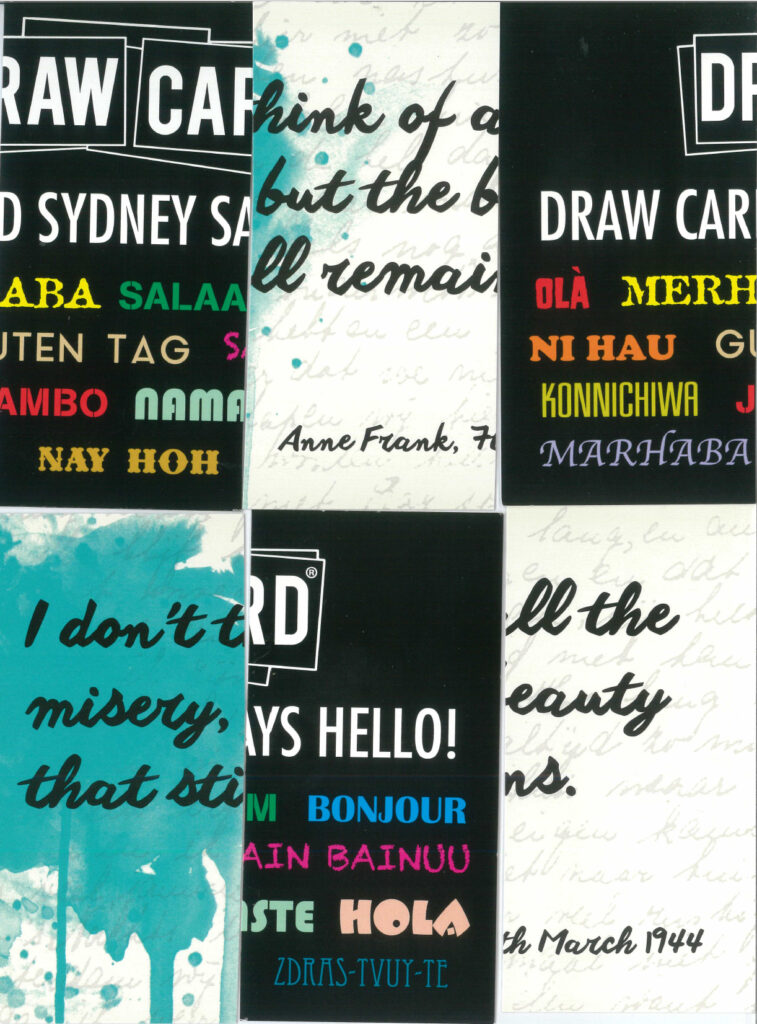
The cards can occasionally be used for quick checks of understanding. When the postcards have two dominant colours, I can ask students to use one colour for a correct answer and the other for an incorrect answer. They simply hold up their postcard, allowing me to see immediately how the class is responding. This gives me a quick indication of whether students have understood and whether something needs to be clarified or revisited.
Writing within a small space
The postcard works well for writing because its small size naturally limits how much students can write. Students have to decide what matters, what can be left out and how an idea can be expressed concisely. This develops audience awareness and purposeful writing.
At beginner level, students might write a holiday message or respond to topics such as university life or an exchange semester.
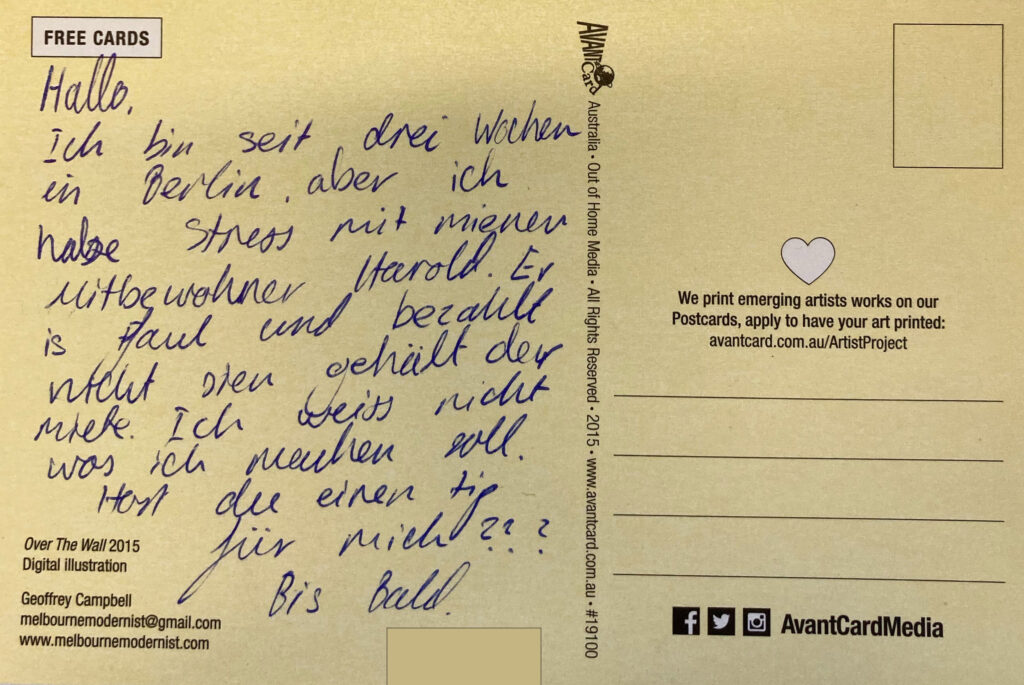
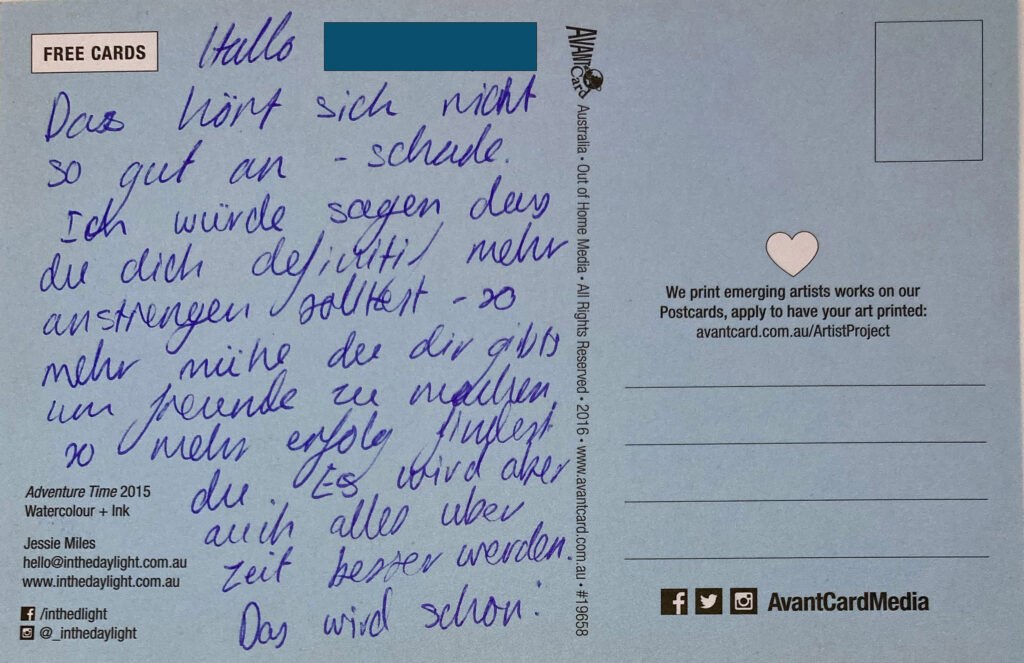
At intermediate level, a postcard can represent a place someone remembers, a family history or an experience of migration. I have found this productive when working with migration. A free postcard can provide the starting point for students to investigate why people leave their home countries and what migration experiences can mean for individuals and families (Lay, 2020). The image provides a personal entry point, while research opens the activity towards wider historical and social questions.
Language through looking
The potential extends well beyond language education. Postcards can open-up questions of reproduction and reception in Art History, provide historical evidence for examining changing representations of places and people, and offer students of Media Studies a compact way of exploring visual framing, audience design and multimodal communication.
Across these different contexts, the image itself deserves as much attention as the accompanying text. I often ask students to look carefully before interpreting. What can they actually see? What is missing? What might the photographer, artist or designer want us to notice? What assumptions do we bring to the image? These questions move students from image description towards visual literacy.
At higher language levels, I can use art postcards to introduce students to museums and artists. The contemporary German artist Gerhard Richter offers a productive example (Lay, 2014). Teaching materials based on Richter’s work draw on postcards, posters, calendars and books to give students different ways of engaging with his paintings, alongside his homepage. Students describe, compare and interpret the works, considering colour, atmosphere, composition and technique.
The postcard also provides an accessible bridge between an original artwork and its reproduction, a relationship that is particularly relevant to Gerhard Richter’s work. Richter’s artistic practice repeatedly explores the movement between photographs, reproductions and paintings, most notably through his Atlas and his photo paintings. Students can therefore ask what changes when a large painting becomes a small image printed on a piece of card, and how the medium, scale and context influence what we see and how we interpret it.
The postcard as historical evidence
Postcards can also become objects of historical inquiry in their own right. A historical postcard does not simply show us what a place looked like. Its image, caption, handwriting, stamp, postmark and material condition can reveal something about its producer, sender, audience and cultural context.
Students can ask questions that historians apply to other primary sources: Who produced this object? For whom? When? What perspective does it represent? What does it leave out?
This makes postcards useful for developing source criticism and historical interpretation. As students examine who produced a postcard, for whom it was intended and what it reveals about everyday life, they evaluate evidence, question assumptions and consider different perspectives. They also need to communicate their interpretation clearly and recognise how cultural context shapes the experiences represented. In this way, the activity supports the University of Sydney’s Graduate Qualities of critical thinking and problem solving, communication and cultural competence.
More than a language exercise
What interests me most is that the postcard brings several forms of meaning making together in a very small space. Students read words, interpret images, make connections, write for an audience and respond to a physical object. They move between description and interpretation, personal experience and historical context.
This makes the postcard a useful entry point into multimodal learning. The principle is not tied to the postcard itself. A museum ticket, photograph, newspaper clipping, exhibition label, map, product package or digital screenshot can generate similar forms of inquiry. What matters is the invitation to look closely, make connections and construct meaning.
From campus to classroom
The postcard has largely lost its former role as a medium of everyday communication, yet it has not disappeared. It survives as a souvenir, advertising medium, collectible and occasional personal message.
Perhaps its educational value lies precisely in this continued presence. In an increasingly digital learning environment, the postcard offers students a tangible connection to an analogue form of communication. It remains familiar while offering something increasingly unusual: a physical object that brings together text, image, materiality and personal choice.
For me, that is the real appeal of the postcard as a teaching resource. It requires little technology, preparation or expense. A teacher can turn them into a wide range of learning activities.
A postcard can help a beginner speak, give an intermediate learner a reason to write, or prompt an advanced student to interpret an image or investigate its historical context. It also offers a simple entry point into object-based learning, where students engage directly with a physical artefact to observe, question, interpret and construct meaning. It can bring an artwork into the classroom, provide evidence for historical inquiry or open discussion about advertising and visual communication.
The postcard may be small, but the learning possibilities are not. Sometimes, a good teaching resource is already sitting in a display stand in a café, on a university campus or in a museum foyer. All we need to do is pick it up and ask a different question.