

Australia’s universities have never been more internationally diverse – and nowhere is that clearer than at the University of Sydney. Yet sit in on almost any staff room and you’ll hear the same quiet challenge: they don’t engage. International students, often the majority in the room, often the most analytically prepared, sit in careful, polite silence while discussion circles among others. We recruit the world into our classrooms, then teach in conditions in which much of what it knows goes unspoken. Alongside growing institutional focus on belonging and wellbeing, the question becomes practical: how do we engage international students, not at the level of policy, but in the classroom? This article argues that one surprisingly powerful answer is translation.
In my postgraduate editing course WRIT6001 Professional Editing, with more than 80% international students in Semester 1, 2026, I made a single structural change: I told students they could speak Mandarin, which two-thirds of the class shared, and invited bilingual classmates to interpret. What followed wasn’t a workaround for a language problem but a pedagogical transformation.
This decision was inspired by a student who I’ll call Vivi (named changed). Halfway through a seminar on cultural rhetoric, Vivi raised her hand, paused, and lowered it again – a fully formed thought colliding with the wall of a second language. “Please, take your time,” I said. She murmured a word to the friend beside her in Mandarin. Three careful words came back, Confucian, modesty, respect, followed by a grin, as if the words were not quite right but were the best she had. Her neighbour leaned in; Vivi’s face lit up, and she spoke rapidly in Mandarin. Her neighbour translated: “she says Chinese rhetoric is guided by Confucian philosophy; it values modesty and respect over argument, contest and confrontation”. The room went quiet for a beat. Then everyone started talking at once: the turning point for how I taught WRIT6001 for the rest of the semester.
Translanguaging, referenced in the title of this piece, is a strategy involving multiple languages within a classroom setting, allowing students and teachers to draw on their full linguistic repertoire during lessons. It recognises and values the languages students already know as resources for learning.
Silence as a problem of trust, not confidence
Units like WRIT6001 draw largely international, mostly Mandarin-speaking students: highly capable people, many with undergraduate degrees in literature or communications, who arrive with sophisticated ideas about language and editorial practice. And yet, in seminars: careful silence. Research on international student experience points to familiar anxieties: fear of grammatical error in front of peers, unfamiliarity with Western discussion norms, and the cognitive load of thinking in one language while performing in another. When content is complex, that load becomes prohibitive — students with real contributions simply do not make them.
The standard response, to encourage participation, cultivate a safe space, deploy think-pair-share, tends to treat silence as a confidence problem when it is often a structural one. McMahon et al. make a related point in a Teaching@Sydney conversation on inclusive teaching: participation is less a marker of confidence than an act of trust, since speaking up asks a student to risk something in front of peers. For a student working in a second language, that risk compounds. They do not engage looks less like reluctance and more like a rational response to risk. You cannot invite someone to feel at ease in a language working against them, you have to change the conditions.
An experiment in translation
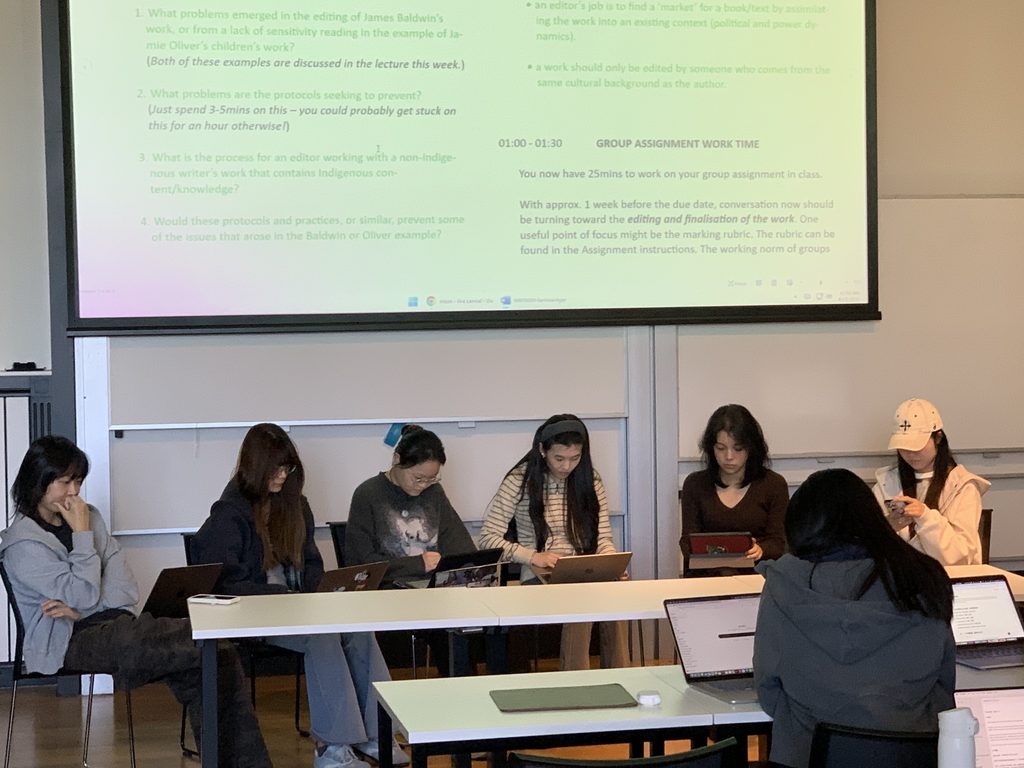
After Vivi’s moment, I made a decision that felt slightly transgressive: from then on, anyone could speak Mandarin if they needed to. I would not understand them, I said so upfront, and the honesty helped. In return, I asked for volunteers willing to interpret for the group. Seven hands went up out of twenty-six students.
What followed was something I hadn’t fully anticipated. The interpreters, who rotated informally, sometimes mid-discussion, did not merely translate words; they translated arguments, conveying content, intent, and rhetorical force, which demanded active listening rarely seen in conventional seminars. Meanwhile, the student speaking Mandarin was freed to articulate a complete, complex idea, not a version simplified to fit their English in the moment.
The effect on engagement was immediate. Students who had barely spoken in the first half of semester were now anchoring entire threads of discussion. The specificity and pushback in the room rose noticeably. Something had shifted — and it was not confidence. It was conditions.
What translation actually teaches
There’s pedagogical beauty here that I find genuinely compelling. One of WRIT6001’s central skills is identifying what a piece of writing is trying to say and helping it say that more clearly, itself an act of translation. By building live translation into the seminar, students were not just accessing content more comfortably; they were enacting the discipline itself. The interpreters were developing sophisticated editorial judgment in real time: how do you render a concept from one cultural framework into another without losing its texture, when there’s no direct equivalent? These are central questions in a globalised publishing industry where editors increasingly work across languages and cultures.
One student-interpreter reflected:
“I had to really understand what they meant before I could say it in English. It made me listen differently, with attention, depth, care and respect”.
Another shared that translating for classmates made her more attuned to the gap between what they meant and what they said in their own English writing – the very gap editors are trained to close.
Ownership, authenticity, and voice
Engagement research, from Boud and Ramsden to the growing literature on belonging in higher education, consistently identifies authenticity as central to meaningful participation. Students engage more honestly when they feel their actual perspective is welcomed, not a polished performance of academic discourse. For international students, the distance between their inner intellectual life and their public academic voice can feel vast, not because the ideas are not there, but because the delivery system keeps failing them. The translation model signalled that the idea mattered more than the language it arrived in, decoupling thinking from fluency and giving students permission to bring their whole selves into the room.
Importantly, this does not require Mandarin speakers or a formal interpreter pool. The underlying principle – to design conditions for authentic expression, then support making that expression legible to the group – transfers across disciplines and cohorts, whether the barrier is a different language or specialist terminology. The form changes; the logic holds.
A cost to academic English skills?
Some might reasonably ask that whether by making room for Mandarin, we risk letting students opt out of the skill they most need in academic writing. I do not think so, for two reasons. First, interpreters are not resting in their first language. Rendering a fully formed idea intact into a second language in real time is closer to professional editing than any standard tutorial task. Second, the Mandarin speaker does not leave English behind: the idea re-enters the room in English within seconds, often with the original speaker rejoining once the discussion has picked it up. The translation is not a substitute for English; it is a running start.
An invitation
I am not suggesting multilingual discussion should replace English-medium instruction, or that this approach is without trade-offs. Some students found the switching disorienting, and there is a genuinely important question, one my students and I discussed openly, about whose labour it is to interpret, and how that labour is recognised. That question does not have a tidy answer. But those are exactly the tensions professional editors navigate daily: fidelity versus fluency, voice versus convention, the author’s meaning versus the reader’s need.
What I took from Vivi – three careful words, a whispered translation, a room that suddenly had more to say – is something I now intend to carry into every seminar. Our students often have far more to offer than our classrooms make room for. Sometimes the most powerful thing we can do as educators is not to teach more, but to listen differently – and sometimes, to let someone else do the listening for us.
The author welcomes conversation about multilingual pedagogies — please feel free to get in touch via email.