
Providing positive and constructive feedback can be the most effective way to support students. This takes various forms, such as in-class discussions or written comments on assignments. Teachers should define feedback as part of a broader intellectual dialogue that enhances students’ academic skills, rather than having students perceive it simply as a comment explaining their grades on their assignments. Viewing feedback in this manner can make the learning experience more meaningful and address challenges with motivation and emotional responses.
Define feedback for your students: Feedback as a continuous process
I have found that a good place to start is to explain this process to students, explicitly clarifying the role of feedback in the first academic session and presenting it as a continuous process occurring throughout the semester, rather than just after each assignment. Personally, I describe my approach to feedback to students during the first session of the class, outlining the types of feedback they can expect throughout the semester. I show them the diagram below, inspired by Stuart Hall’s circuit of culture and explain my approach to feedback.
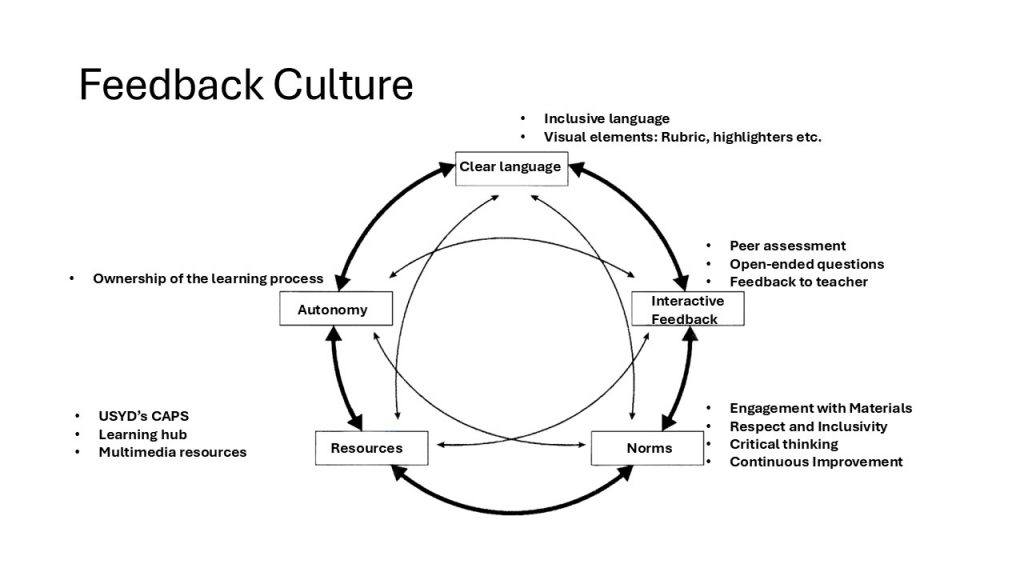
According to each unit’s outline, this can be adjusted, and the details, such as the class norms, can be shaped through discussion with each class. I discuss what I expect from them and what they can expect from me to build the norms of the class. We discuss our class routines and the assignments to form the idea of a feedback culture.
I insist that feedback is not merely a task or a project that happens just after their assignments.
Together, we discuss it as a process, and I try to guide the conversation to shape feedback as a continuous process that is necessary for me as a teacher and for them as students.
The importance of peer assessment: Demonstrate how feedback facilitates everyone’s growth
While there are additional strategies, I have found that it is crucial to emphasise the importance of peer assessment. Despite its absence in most units, weekly questions that prompt students to answer can create an opportunity for them to review each other’s responses and offer feedback under the teacher’s supervision. So, their weekly answers become the topic of our discussions. The informal feedback that occurs in class takes the form of dialogue challenging their ideas rather than just pointing out what is wrong with their answers or offering tips on how they can improve. Therefore, giving and receiving feedback becomes integral to enriching the discussion on the weekly topic. That is, I see their weekly posts as passive individual thoughts that in class, we try to convert them into active collective knowledge.
giving and receiving feedback becomes integral to enriching the discussion on the weekly topic
My students in SCLG1001 and SCLG1002 receive general feedback on discussion posts each week leading up to week 5, focusing on how to improve their answers for the rest of the semester.
Each week, I allocate five minutes for students to review each other’s recent discussion posts and provide feedback. During this time, I join their groups as much as possible to engage in discussions, ensuring that I connect with each group by week five. After these five minutes, I provide general feedback on their discussion posts, addressing common issues I’ve noticed in their answers and highlighting how they can improve their responses.
This peer assessment process fosters a collaborative learning environment and also enhances their understanding of the unit criteria. By engaging with one another’s work, students gain valuable insights into the expectations of academic writing and critical analysis. It allows them to see different perspectives and approaches, which can deepen their comprehension of the subject matter. This understanding of feedback in practice supports students in interpreting feedback, assists them in developing strategies for its application, encourages them to engage in dialogic interactions with teachers, and provides space for students to develop their feedback receptiveness skills. Therefore, by working closely with the students, we can bridge the gap between feedback transmission and feedback reception. One student has reflected:
“The feedback Habib provided on my discussion post was super helpful. They helped me grasp things better in the first few tutorials, and I’ve been able to improve my weekly marks.”
Provide explicit written feedback: Use the marking options in Canvas Speedgrader in a meaningful way
We often hear about the importance of clear feedback and understand why responses like “this is not enough”, “bad”, or “huh?” are not effective when responding to students’ ideas. Consequently, feedback that is clear, specific, and actionable is more likely to engage students. Identifying strengths and areas for improvement and formulating actions to enhance performance based on the feedback make the process more organic. Maintaining a conversational tone in our written feedback reinforces the idea that we are in dialogue with students, encouraging them not only to read all the comments but also to reflect on their work. I use various highlighters to identify certain issues. For example, in marking mid-semester essays, I mark repetitive words in blue and long sentences in yellow. Therefore, when I write, “your sentences are too long” or “avoid repetitive words”, those sentences and words are already highlighted in the text. I will also notify students about this use of colours in the first session after releasing the marks to draw their attention to the feedback. Believe it or not, many students do not even know teachers put in-text comments on their work! This seems to work for my students:
“I just wanted to say thank you so much for your detailed feedback on my midterm essay. I have never received feedback so helpful before! I will definitely take it on board!”
Also, in formal written feedback, I avoid verbs such as “deliver” and “provide”, as this language positions students as passive receivers of information. Instead, I use verbs such as “receive” and “get” in my feedback. Also, where I see students putting into practice the previous informal and formal feedback and discussions, or when I want to refer to future actions, I use verbs such as “analyse”, “explore”, and “apply”.
Providing learning resources: Link your feedback to the available resources at the University
Occasionally, attaching extra materials on the topic, sharing resources and valuable pages on the University website, or helping them with their writing skills can be useful. For example, I introduce various Learning Hub workshops to first year students and share the links to these workshops. I attach a variety of faculty resources on building arguments, being critical, or materials on academic integrity when needed. In this way, students can access many materials of which they are not aware of and also learn about university resources that exist to support their academic journey. Students have appreciated this approach:
“Habib took great initiative by sending resources that would be helpful for our development. For me personally, this included a university-approved factsheet on critical thinking, which I believe helped me improve my essay writing for the take-home assessment.”
In addition to these resources, I also suggest various films and articles related to the topics we cover, extending beyond the standard reading list. By incorporating these materials, I aim to connect the course content to their daily life practices, making their learning experience more meaningful and relevant. For instance, when discussing social issues, I might recommend documentaries or films that provide visual insights into the topics at hand. This not only enriches their understanding but also encourages them to think critically about the subject matter in the context of real-world applications.
Moreover, I often direct them to articles that explore contemporary issues, offering different perspectives that stimulate discussion and reflection. This approach helps students see the relevance of academic concepts in their everyday lives, bridging the gap between theory and practice.
Fostering a feedback culture: Encourage giving and receiving feedback
However, this isn’t solely about the feedback teachers provide to students; it’s crucial to remember that we are engaged in a dialogue! Defining feedback, explaining it, and practically giving feedback in class can prepare students for mid-semester feedback session, where they can express what they think about the first half of the semester. Students can share their preferences regarding sessions, liked and disliked topics, useful activities, and less efficient ones. This feedback not only serves as a valuable source for teachers to reflect on their teaching methods but also offers students a chance to critically review their effort, time, and educational journey, planning for the future. Such feedback can bring students and teachers closer, fostering a more inclusive atmosphere. It can boost students’ confidence, empower them, enhance their agentic engagement, and support their autonomy. The feedback can be shared anonymously or through in-person discussions, depending on the relationship between the teacher and students in that specific class. If it’s your first time starting this process, I suggest using an anonymous feedback form. After a couple of semesters, when you are more experienced and confident in receiving student feedback and building that human relationship, you can transition to group and class discussions.
feedback, when viewed as part of an ongoing intellectual dialogue, becomes a powerful tool for supporting students
Feedback plays a crucial role in shaping students’ current experiences and directing their future educational endeavours. By enhancing student engagement with feedback, educators can create a more meaningful learning experience. Positive and constructive feedback, when viewed as part of an ongoing intellectual dialogue, becomes a powerful tool for supporting students. The continuous process of feedback, aids students in understating and applying feedback effectively. Through thoughtful feedback practices, educators and students can collaboratively shape a more enriching and empowering educational journey.