

Sustaining and maintaining teaching innovation for a new normal
This University-wide symposium on Wednesday 14 July 2021 celebrated simple and shareable innovations in active learning and assessment from the past year. The aim of this was to highlight the approaches to teaching and assessment developed by colleagues across the University, and to come together and share practice and ideas.
Symposium program
[wpcs_schedule date=”2021-07-14″ session_link=”none”]
Get further equipped for teaching in the new normal
Following the symposium, a number of professional learning workshops will be run to further equip Sydney educators
with the tools to redesign their curriculum, delivery, student support and engagement, and assessment approaches.
They will be delivered by Educational Innovation with assistance from experienced teachers from across the institution.
- Modular Professional Learning Framework winter school
- Tuesday 13 July – Module 04
Curriculum design and constructive alignment - Friday 16 July – Module 05
Assessment and feedback for learning - Monday 19 July – Module 01
Principles of learning and teaching
and Module 08
Engaging students in lectures and large classes - Tuesday 20 July – Module 03 Inclusivity and diversity and Module 06
Supporting student cohorts and teaching teams - Wednesday 21 July – Module 13
Designing for blended and online learning and Module 14
Online tools for interactive and collaborative learning - Thursday 22 July – Module 15
Creating and using educational media - Tuesday 27 July – Module 21
Supporting interdisciplinary learning
- Tuesday 13 July – Module 04
- Teaching in HyFlex workshops – be equipped with practical approaches to teach classes where students are online and in-person, simultaneously. Update: Given the COVID restrictions in Greater Sydney, these workshops will run slightly differently.
- All-in-one workshops: Friday 30 July, Monday 2 August, Tuesday 3 August
- Drop-in HyFlex clinics – find a session and book
- Student Relationship Engagement System (SRES) workshops – build stronger relationships and engage your students personally, at scale
- Beginners: Monday 26 July, Thursday 29 July
- Masterclass: Tuesday 3 August
- Zoom workshops – pick up tips and approaches for effective Zoom teaching
Sydney educators can also book a 30 minute online consultation with an educational designer at any time.
Keynote resources
Keynote by Professor Peter Felten, Elon University.
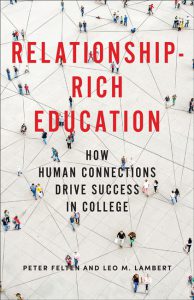
Relationship-Rich Education: How Human Connections Drive Success in College
Authors: Peter Felten and Leo M. Lambert
More information:
https://www.centerforengagedlearning.org/books/relationship-rich-education/
Responses to follow-up questions
Peter Felten has also posted thoughtful responses to the questions that we didn’t have time to address in the keynote Q&A: https://bit.ly/2TeqP9j
Recording: Relationship-rich education and the ‘new normal’
Download the slidedeck (PDF, 22 MB)
Student panel recording
Concurrent session recordings
- Session 1
- Track A
- [1A1] Building connection and belonging in large remote and on-campus cohorts
Alix Thoeming, Anastasiya Byesyedina, and Tara Smith - [1A2] Physics@Home: Authentic experiments and community building online and anywhere
Tara Murphy and Mike Wheatland - [1A3] Replacing placements with authentic, simulated experiences for work-integrated learning
Elizabeth Bourne, Amani Bell, Robyn Johnson - Q&A panel
- [1A1] Building connection and belonging in large remote and on-campus cohorts
- Track B
- [1B1] Improving student learning and academic integrity by replacing exams with supported authentic reflections
Robyn Martin - [1B2] Data, storms, and a film festival: Transforming field trips for the new normal
Ana Vila-Concejo and Tristan Salles - [1B3] Flexible authentic assessment to promote group work, enhance communication skills and foster research inquiry
Clara Sitbon - Q&A panel
- [1B1] Improving student learning and academic integrity by replacing exams with supported authentic reflections
- Track C
- Track A
- Session 2
- Track A
- [2A1] From teacher-telling to student-doing: Changing engineering teaching to support case-based groupwork
Fatima Afzal - [2A2] Cementing student understanding through a jigsaw of groupwork and team teaching
Elizabeth Cayanan - [2A3] A structured case-based groupwork to enhance online collaboration
Corina Raduescu, Jeffrey Lo - Q&A panel
- [2A1] From teacher-telling to student-doing: Changing engineering teaching to support case-based groupwork
- Track B
- [2B1] Preparing students for the new normal using flipped classrooms, authentic challenges and student voice
Maria Ishkova, Vanessa Loh, Georgia White, Oliver Lawton, Jenna Tyson, Herman Fung, and Mina Askovic - [2B2] How journals enhanced student engagement with pre-readings and supported assessment preparation
Ben Brown - [2B3] An ‘active learning ecosystem’ to transform online student collaboration and time-efficient support
Andy Smidt - Q&A panel
- [2B1] Preparing students for the new normal using flipped classrooms, authentic challenges and student voice
- Track C
- [2C1] Stepping back so students can step up: How sharing rich media online can open up true collaboration
Angela Hecimovic and Robert Morley - [2C2] Connecting student teams and industry experts across the globe in project-based learning
John Kavanagh, Graham Madsen, Claudia Moratti - [2C3] Encouraging thoughtful student peer feedback using thinking hats online
Helena Robinson - Q&A panel
- [2C1] Stepping back so students can step up: How sharing rich media online can open up true collaboration
- Track A
Session 1 Track A
[1A1] Building connection and belonging in large remote and on-campus cohorts – Alix Thoeming, Anastasiya Byesyedina, and Tara Smith
[1A2] Physics@Home: Authentic experiments and community building online and anywhere – Tara Murphy and Mike Wheatland
[1A3] Replacing placements with authentic, simulated experiences for work-integrated learning – Elizabeth Bourne, Amani Bell, Robyn Johnson
Q&A panel
Session 1 Track B
[1B1] Improving student learning and academic integrity by replacing exams with supported authentic reflections – Robyn Martin
[1B2] Data, storms, and a film festival: Transforming field trips for the new normal – Ana Vila-Concejo and Tristan Salles
[1B3] Flexible authentic assessment to promote group work, enhance communication skills and foster research inquiry – Clara Sitbon
<h4id=”1AQ”>Q&A panel
Session 1 Track C
[1C1] How ‘true’ HyFlex can foster community, engagement, and relationship –
Tamara Neal
[1C2] Stimulating higher order thinking by gamifying HyFlex learning activities – Eryn Werry
[1C3] Engaging students as co-creators of simple but effective HyFlex experiences –
Sue Randall
Q&A panel
Session 2 Track A
[2A1] From teacher-telling to student-doing: Changing engineering teaching to support case-based groupwork – Fatima Afzal
[2A2] Cementing student understanding through a jigsaw of groupwork and team teaching – Elizabeth Cayanan
[2A3] A structured case-based groupwork to enhance online collaboration – Corina Raduescu, Jeffrey Lo
Q&A panel
Session 2 Track B
[2B1] Preparing students for the new normal using flipped classrooms, authentic challenges and student voice –
Maria Ishkova, Vanessa Loh, Georgia White, Oliver Lawton, Jenna Tyson, Herman Fung, and Mina Askovic
[2B2] How journals enhanced student engagement with pre-readings and supported assessment preparation –
Ben Brown
[2B3] An ‘active learning ecosystem’ to transform online student collaboration and time-efficient support –
Andy Smidt
Q&A panel
Session 2 Track C
[2C1] Stepping back so students can step up: How sharing rich media online can open up true collaboration –
Angela Hecimovic and Robert Morley
[2C2] Connecting student teams and industry experts across the globe in project-based learning –
John Kavanagh, Graham Madsen, Claudia Moratti
[2C3] Encouraging thoughtful student peer feedback using thinking hats online –
Helena Robinson
Q&A panel
More information
This symposium is being organised by the Educational Innovation team in the DVC (Education) Portfolio, and is led by Eszter Kalman, Adam Bridgeman, and Danny Liu.
To contact us, please email [email protected].